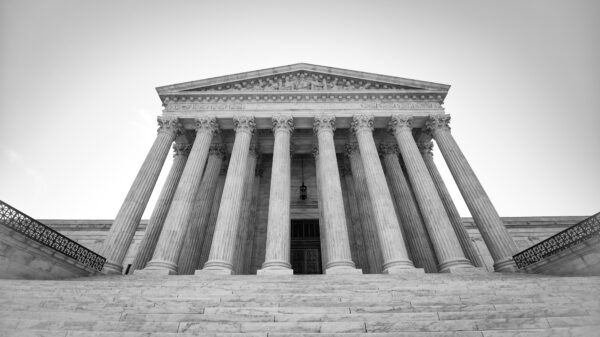




































The Constitution has not changed a word. But the Supreme Court has changed the direction of its protection.
The change developed over decades. It started as a contested legal theory in the late 20th century, took doctrinal form under the Rehnquist Court and became increasingly dominant under the Roberts Court. After 2020, the transformation accelerated. That change in direction is part of a broader national unease: The institutions remain familiar, but the principle governing them no longer feels secure.
Individual liberty is now increasingly required to prove its ancestry. A right the Constitution does not expressly name must be traced to traditions established by generations long dead. Presidential power receives broader treatment. Powers the Constitution does not expressly grant may be inferred from its structure, the necessities of the office and the Court’s conception of an energetic executive.
Government has always had ample incentive to become more powerful. The individual has always needed the Constitution to stand between liberty and power.
James Madison saw the danger before the Bill of Rights had even been written.
Put certain freedoms on paper, he understood, and government might one day claim that every freedom left off the list had been surrendered. A document intended to protect liberty could be turned into a limit on liberty.
When Madison rose in the House of Representatives on June 8, 1789, he warned that enumerating particular rights might “disparage those rights which were not placed in that enumeration.” He called it one of the strongest arguments against adopting a bill of rights. Then he set about guarding against it.
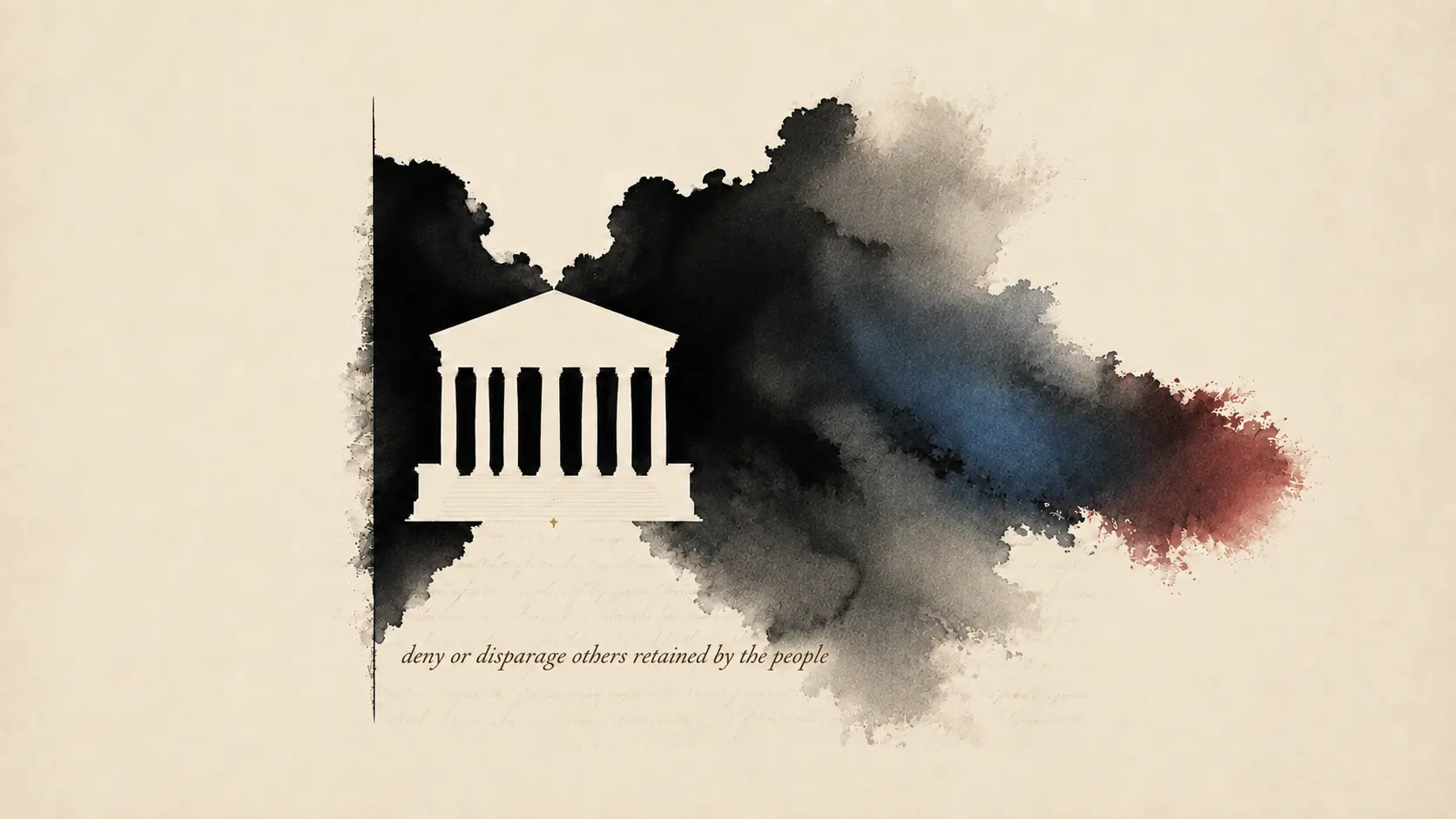
The result was the Ninth Amendment: “The enumeration in the Constitution, of certain rights, shall not be construed to deny or disparage others retained by the people.”
Those words provide a warning about the scope of constitutional liberty. The amendment leaves unenumerated rights undefined and provides no simple test for recognizing one. Its warning is plain: The written Constitution is an incomplete inventory of human liberty. Constitutional silence does not amount to constitutional surrender.
Courts have always consulted history. It can illuminate constitutional language and restrain judicial preference. A comparatively modern approach uses history as a veto: A specific liberty must have been recognized by earlier generations before the Constitution can protect it today.
In Palko v. Connecticut in 1937, the Court asked whether a right was rooted in the traditions and conscience of the American people and implicit in ordered liberty—a historical inquiry joined to the larger question of justice.
In Moore v. East Cleveland in 1977, the Court invoked the now-familiar phrase “deeply rooted in this Nation’s history and tradition” to protect an extended family from a housing ordinance. History supported liberty while leaving room for constitutional protection to extend further.
That approach understood the Constitution as an enduring charter. Its words remain fixed while broad guarantees govern circumstances its authors could not foresee. Chief Justice John Marshall captured that necessity in McCulloch v. Maryland, describing a Constitution “intended to endure for ages to come.”
The modern challenge to that understanding became unmistakable with Robert Bork. He became one of the most influential modern advocates for using historical interpretation as a restraint on unenumerated rights. Bork argued that judges should enforce rights grounded in constitutional text or demonstrable original understanding and sharply criticized Griswold v. Connecticut, which recognized marital privacy even though the Constitution does not name it.
During his 1987 confirmation hearing for a seat on the Supreme Court, Bork compared the Ninth Amendment to a constitutional provision partly obscured by an inkblot: If its meaning could not be determined, a judge could not supply it. Bork’s entire record was before the Senate, and his views on privacy, originalism and unenumerated rights became central to the national argument. His nomination was rejected 58-42.
A view of unenumerated rights that remained deeply controversial when Bork defended it now sits near the center of the Supreme Court’s constitutional method.
In Washington v. Glucksberg in 1997, the Rehnquist Court gave the restrictive approach its modern doctrinal form. A claimed liberty had to be carefully described and shown to be deeply rooted in the nation’s history and tradition.
Even then, history sometimes left room for constitutional protection beyond longstanding tradition. In Lawrence v. Texas, the Court invalidated laws criminalizing private, consensual same-sex intimacy despite their historical pedigree. In Obergefell v. Hodges, the majority said history and tradition should “guide and discipline” the inquiry while allowing constitutional liberty to extend beyond historical boundaries.
History could guide liberty while allowing each generation to apply constitutional principles to its own circumstances.
The Roberts Court’s decision in Dobbs v. Jackson Women’s Health Organization moved in a different direction. The majority emphasized that the Constitution makes no express reference to abortion and concluded that the asserted right was not deeply rooted in American history and tradition. On that basis, it overturned Roe v. Wade and Planned Parenthood v. Casey.
Roe and Casey drew substantial constitutional criticism. Many Americans and jurists believed those decisions went beyond the text and removed a profound moral question from democratic debate. Others understood them as indispensable protections of bodily autonomy, privacy and women’s equal citizenship. Any honest discussion should acknowledge both the constitutional controversy and the human stakes.
The argument here concerns the role Dobbs assigned to history in deciding whether constitutional protection exists.
Dobbs promoted history from a guide to a gatekeeper. It allowed generations living under radically different social, medical and political conditions to decide where constitutional protection must end in ours.
In 1791, slavery remained embedded in law. In 1868, women could not vote, and Black citizenship was newly guaranteed and violently contested. Many Americans had no voice in defining the traditions by which their descendants’ rights would later be judged.
Rights belong to the living as constitutional guarantees. When the exclusions of the past become the test for liberty in the present, history perpetuates the very injustices constitutional government is supposed to overcome.
The change becomes clearest when individual liberty is compared with presidential power.
The Warren Court’s defining question was often: What may government do to a person? In Brown, Mapp, Gideon, Miranda, Griswold and Loving, the Court placed the Constitution between the individual and government power.
The Burger Court followed a more varied course. When Richard Nixon claimed an absolute privilege to withhold evidence in a criminal proceeding, a unanimous Court rejected him in United States v. Nixon. Presidential responsibilities remained subject to the ordinary demands of justice.
Earlier courts failed to protect many people, and the Roberts Court has protected rights involving firearms, religious exercise and speech while sometimes rejecting presidential claims. But its center of gravity has changed.
The Roberts Court has ended the federal constitutional protection for abortion, struck down the Voting Rights Act’s coverage formula for preclearance and narrowed the circumstances in which individuals may recover damages from federal officers who violate constitutional rights.
At the same time, it has shown considerably more flexibility when considering presidential power. The Constitution contains no express criminal immunity for former presidents. The sweeping removal powers the Court has attributed to the presidency also arise through inference from constitutional structure and the majority’s understanding of what an energetic executive requires.
A Court may reasonably demand discipline before recognizing an unenumerated right. Consistent constitutional interpretation requires comparable discipline when presidential powers also depend on structure, implication and necessity.
The current method points in a discernible direction.
Liberty without an explicit textual home receives heightened scrutiny. Presidential power without one may receive recognition as a structural necessity. History disciplines the individual, while implication empowers the president.
The Constitution’s words are fixed. The question is whether history guides enduring principles or freezes liberty where earlier generations left it while presidential power continues to grow.
This is larger than one president, party or disputed right. The doctrines established today will remain available to whoever occupies the White House tomorrow.
Presidents will change. The power will remain.
Madison could not foresee digital surveillance, genetic databases, artificial intelligence or technology capable of recording nearly every movement of an individual’s life. He could not name the freedoms that might be threatened by powers that did not yet exist.
His solution anticipated that uncertainty.
The founders constrained judicial power while preserving constitutional liberty beyond an enumerated list. The Constitution was written to keep government power within bounds.
Madison understood that freedom could extend beyond the rights his generation had the wisdom to name. Marshall understood that the Constitution had to endure a future its authors could see only dimly.
History should discipline judges while leaving liberty capable of enduring.
When history becomes liberty’s prison while presidential power continues to grow, Madison’s warning is turned on its head.