
















Growing up in the first capital city of the Confederacy in the ‘40s and ‘50s, I was indoctrinated with the reasons for segregation and reverence for the Old South. Even public school textbooks and the then-Alabama Department of Archives and History, near which I early lived, sought to justify each, as did most relatives. I was influenced also by a racist father who died during the Montgomery Bus Boycott when I was 14, and by a moderate-in-all-things mother who tried to temper his audible racism and to mediate the racist world into which she brought me 84+ years ago.
I began to question seriously he basis of the racial regime of which I was a part as early as grammar school, after reading a biography of America’s first great Black diplomat, Ralph Bunche. He won the 1950 Nobel Peace Prize for his work in the Middle East. He was the first non-athlete, non-entertainer Black professional I ever “met.” I evolved thereafter, slowly at first, into a civil rights advocate by the time I had graduated the second time from Auburn University.
As SGA President (1963-64), I’d helped my Alma Mater integrate during my senior year and stayed on campus to earn a master’s degree in 1965, finishing my thesis on the KKK and its fight to deny Alabama’s then-U.S. Senator Oscar W. Underwood, the 1924 Democratic Party nomination for President. While working in my campus office on the somewhat controversial thesis the night of March 11, during the 1965 Selma protests, I had a “great awakening” on race – one that energized my incipient civil rights enthusiasm six months before I began my four decade-long teaching career at Auburn, finishing decades later at Troy University in 2014.
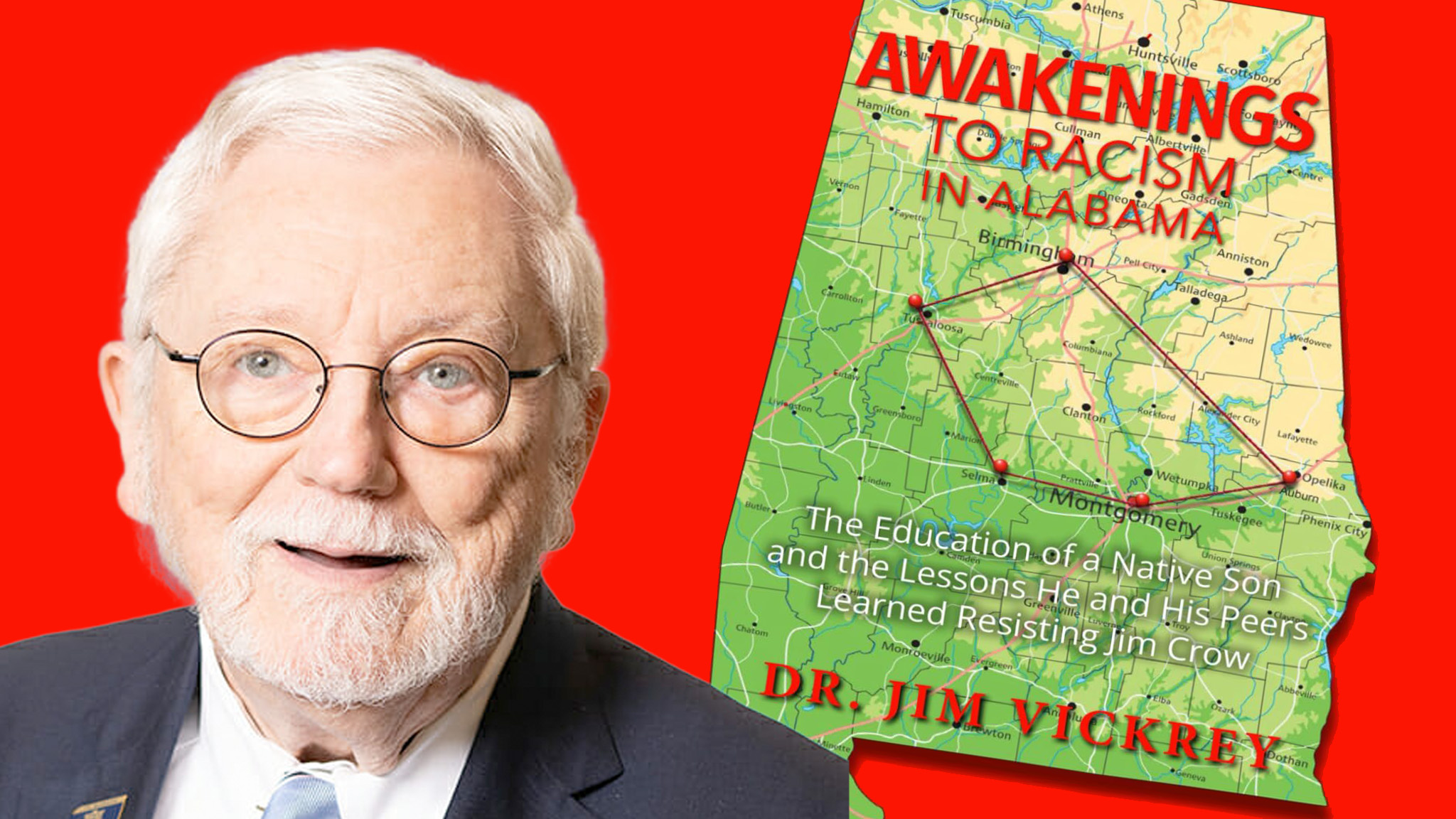
Why did I change, when so many of my peers did not seem to, or as much? I reflected on that question for years, leading eventually to the writing of my third book in retirement — about my racial journey. “AWAKENINGS TO RACISM IN ALABAMA: The Education of a Native Son and the Lessons He and His Peers Learned Resisting Jim Crow (2025),” available locally at the EJI and NewSouth bookstores and from Amazon. In 13 chapters and 648 pages of primary text, plus a 500+ item annotated bibliography and an appendix with original writings from me and others, ending each chapter with two to three “lessons.” I describe the major events in my life (including their political, religious and social contexts) that played a role in the evolution of my feelings and thinking about race, as well as similar but less dramatic experiences of some 20 of my professional friends.
The book begins with a slightly imagined recent conversation about race with my oldest friend (we met, crawling, in 1943) and concludes with an entirely imagined conversation in 1956 with my late father. (I added the imaginary coda to the book to give him an opportunity to speak for himself, which he did, surprising me.) In between, I relate the major events in my life – from befriending Lowndes Countian “Blue Jesus,” my first Black friend, to becoming outspoken on civil rights for six decades, particularly as an Alabama college president. I’ve included happenings in the state and nation that had significant effects on me and my peers. Mine are documented from dozens of journals, notebooks, and scrapbooks I’ve kept since the ‘60s, supplemented by extensive research so that AWAKENINGS is not merely a collection of personal memories.
Most of my experiences happened within the “civil rights pentagon,” marked out on the Alabama map dominating the cover of the book, with “thumbtacks” inserted on Montgomery (where the modern movement started on the buses I was riding), Auburn (where I helped), Birmingham (where the modern civil rights movement was revitalized in 1963), Tuscaloosa (where Gov. George Wallace made his feckless “stand in the schoolhouse door”), and Selma (whence came the political will to enact the 1965 Voting Rights Act that our “Republican” SCOTUS has all but obliterated on policy grounds). I’ve spent 90 percent of my life within the confines of that space, about the size of the geography Jesus walked. I did not mean to exclude from consideration, however, other areas of the state that figured in the Movement I witnessed – from Monroeville (whence came Nelle Harper Lee’s TKAM, the novel that sent me to law school) to Tuskegee (where I studied the Booker T. Washington papers for a course I was teaching at Auburn and became a fan of the Tuskegee Airmen) and Talladega (whence came Auburn’s first Black student, the late Harold Franklin, who became a friend, as did his lawyer, Fred Gray).
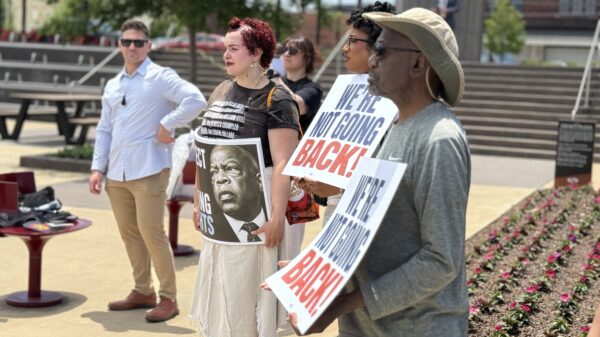
As a result of the evolution of my empathy for civil rights, I was proud to play a leading role in the state’s efforts in the ‘70s and ‘80s to deal with the lingering effects of Jim Crow segregation. As president of the University of Montevallo, I helped draft, approve and execute perhaps the first comprehensive affirmative action plan in Alabama higher education – something I’d also done at the University of South Florida, without using the currently radioactive rhetoric of DEI and without “reverse discrimination.” (As a result, UM was excused from the statewide, federal desegregation lawsuit in the ‘80s. I also helped to desegregate the nation’s founding Kiwanis Club in Birmingham.) Now, of course, such actions are under attack throughout America, based on a strained, new, unjustified interpretation of federal civil rights laws by the Trump administration. Those laws were enacted in the ‘60s and ‘70s when the nation “woke” up to civil rights. We need to be “re-awakened” (the meaning of “woke”) to return to the business of overcoming the lingering effects of three centuries of slavery and segregation. You don’t do it in 60 years! Despite some painful, narrow-minded policy rulings of the SCOTUS, our country has not moved much beyond the need for their continuing enforcement to pay off the palpable, evidence-based “costs of racism,” which are documented in my book. Observe what’s been done in Alabama since the Court’s last voting rights decision: reverting to the ethos of the ‘50s.
But AWAKENINGS is about more than race. Its pages include my travels to half of the states of the Union and my encounters with the people there and here. They include two U.S. Presidents and two VPs in four WH visits and many movie artisans and stars in Hollywood and elsewhere, whom I met as a regular movie reviewer for state media and as a member of the Alabama Film Commission. The pages also include encounters with civil rights leaders here and elsewhere, including Dr. MLK King, Jr., EJI’s Bryan Stevenson, Solomon Seay, Billy Graham (Christendom could use his example now), Fred Gray, millionaire businessman A.G. Gaston, revered Black historian John Hope Franklin and sociologist Dr. Kenneth B. Clark who influenced Brown v. Board. They feature meetings with such luminaries, who stood up for civil rights, as Sidney Poitier, Kirk Douglas, Charlton Heston, Oscar-winning composer Johnny Green, Gregory Peck, Woody Strode and others. Not to be forgotten are other persons famous in their fields, including such jurists as Alabamian Justice Hugo Black, who ironically helped me with my thesis on Senator Underwood and the KKK, my friend and mentor, Judge Frank M. Johnson, TV journalist Bill Moyers, First Ladies Barbara Bush and Rosalyn Carter (who had a Montevallo connection), Judges and Governors George C. Wallace and John Patterson, and Former Secretary of State Dean Rusk, as well as higher educational leaders and coaches, including Father Ted Hesburgh at Notre Dame, UC Chancellor Clark Kerr, Hannah Gray, Yale VP and the University of Chicago’s first female president, Dr. King’s mentor – Morehouse President Dr. Benjamin Mays, Montgomerian Cecil Mackey, the Exec. VP at FSU who hired me, later heading USF, Texas Tech and Michigan State University, and coaches Bobby Bowden, Paul Bryant, Pat Dye and close friends Shug Jordan and Gene Bartow, among others. Not to be forgotten are such cultural icons as Tony-winning dramatist Edward Albee, “Star Wars”-influencing mythologist Joseph Campbell, prize-winning author Jon Meacham, futurist and media-guru Marshall McLuhan, Southern author Eudora Welty, and actor/spaceman William Shatner and poet Leonard Nimoy.
Topics directly covered in the book include autograph and autographed book collecting; my coin, stamp and movie memorabilia collections; college administration with an emphasis on decision-making, institutional planning and ethical behavior (utilizing the lesson I learned directly from Watergate hero William Ruckelshaus and from Harvard Business School faculty); college honors programs (including the Rhodes Scholar competition in which I was once Auburn’s candidate, about which I offer recommendations); orderly decision-making in every field (using the process I developed in my college leadership courses); devising institutional and statewide equal opportunity programs and making the case for why they are still needed; how to be successful in law school (where I was first in my class and on the law review the first year) and other professional graduate programs; implementing an award-winning K-12, city-wide cooperative program between a college and local public schools; marrying right the second time around; movie-reviewing; parenting, a subject in which I’m less expert than in some others; religion and why I did not become a United Methodist minister; public speaking (particularly the speech of introduction, the worst speech regularly given in our society and so my favorite speech to give and to teach); being honored for fighting book censorship; and teaching serious college students of every race, before the advent of most contemporary technological changes, the utility of some of which I still doubt, the continuing value of the liberal arts that prepare students for their last jobs.
On every page of AWAKENINGS, I have tried to be candid, clear, consistent and as compelling as I know how to be, without embarrassing anyone I know. My friends have told me that, while they’ve yet to read the book from cover to cover, they have found it unusually “interesting” to open to any page and to read there, for it is so fact- and example-filled. I didn’t set out to write it that way; indeed, it’s probably overly organized, as a perusal of the Table of Contents well illustrates. But, it’s probably accurately described that way. At any rate, so far I’ve yet to be hammered with a bad ”review.” I welcome one. That may be due to the limited sales and book signings in Montgomery, Auburn and Fairhope, perhaps because it’s overly long, with overly long sentences. NewSouth Books sold every copy available at my SRO book signing there for a hundred or so readers. Books-a-Million won’t stock it.
Immodestly, I’ll conclude with what some readers of AWAKENINGS have said about it: SPLC’s co-founder Morris Dees said of it, “[Y]our story is very complete and heartwarming,” adding I was “a very good writer.” Others have written, “Your book is a treasure of stories, ideas, memories and reflections. … It is interesting to me that in this day and age I [myself] am still getting into trouble with my friends over race.” And “The book is a gift that ‘keeps on giving’ …. I am learning challenging insights on every page. … The book is very detailed and factual. History enthusiasts will especially like the book.” My friendly critic Dr. Bert Hitchcock, former head of the English Department and Hargis Professor of American Literature Emeritus at Auburn, who, as I, was mentored by AU English professor Ruth Faulk, wrote on the review page of the website (vickreysawakening.com): “AWAKENINGS … can be said to be the book of a lifetime. It is hard to imagine but easy to appreciate all the time, effort, and concern that went into creating this detailed autobiographical volume. … A singular maybe even a signature work, AWAKENINGS is a distinctive book by a distinguished Alabamian.” Others have said it’s a good buy: 769 pages for $25 – some 31 pages a dollar!
Regardless, I wrote the book, in part, to underscore a larger point. Before we can make real progress, human progress, in Alabama, the South and in the nation, we must undeceive ourselves, beginning with race – its history and its present impact on us. That means learning our factual history, not the fanciful one millions of us have been taught. I mean, in particular, the facts of Reconstruction and the post-Civil War Amendments that won the Second American Revolution that some in our country are still in denial about, including the U.S. Supreme Court.