



































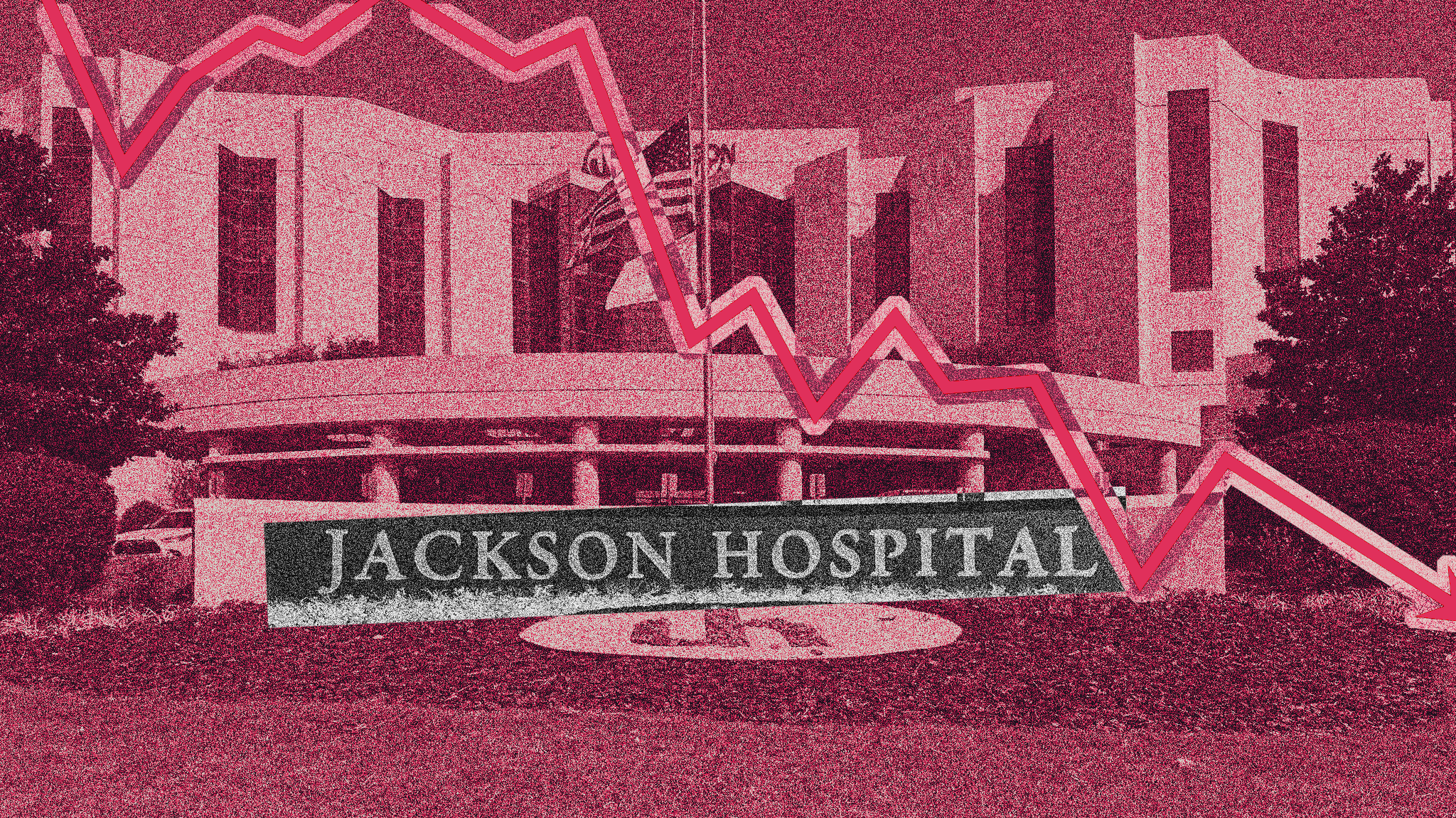
Jackson Hospital’s warning that it could close as early as July is being framed by hospital leaders as a reimbursement crisis with Blue Cross and Blue Shield of Alabama.
But the hospital’s own financial history tells a longer, more complicated story.
In a memo now circulating among health care, business and political leaders, Jackson Hospital President and CEO John D. Quinlivan warned that the hospital’s board has authorized preparations for closure if an agreement with Blue Cross is not reached by June 25.
“We are genuinely running out of money,” Quinlivan wrote, rejecting suggestions that the closure warning is merely a negotiating tactic.
The memo places Blue Cross at the center of the hospital’s struggle and suggests the insurer’s reimbursement rates have become the decisive factor in Jackson’s future.
Quinlivan told WSFA that an outside assessment found Blue Cross reimburses Jackson at rates about 71 percent below those paid to Baptist Medical Center South. The assessment was not publicly released, and it was not immediately clear whether the comparison adjusted for differences in patient acuity, case mix, specialty services or other factors that can significantly affect hospital reimbursement levels.
Yet public records show Jackson’s financial instability long predates its current dispute with Blue Cross.
How does a hospital increase revenue by more than 80 percent over a decade and still end up in bankruptcy?
That question sits at the center of Jackson’s current crisis.
According to IRS Form 990 filings previously reviewed by APR, Jackson Hospital’s annual revenue grew from about $183.5 million in 2011 to nearly $333 million in 2022—an increase of more than 80 percent.
Despite that growth, the hospital reported losses in six of those 12 years.
Even during profitable years, operating margins were frequently less than 2 percent.
Its most recent publicly available filing showed a loss of about $8.4 million in 2022 despite record revenue.
Those financial struggles eventually culminated in Chapter 11 bankruptcy protection.
As part of its restructuring, Jackson secured up to $35 million in debtor-in-possession financing from Jackson Investment Group.
Court records show the financing carries a 14 percent interest rate that rises to 19 percent upon default. The agreement grants the lender a priority claim on nearly all hospital assets and substantial influence over the restructuring process.
Only after those developments did the current fight with Blue Cross move fully into public view.
Jackson later sued Blue Cross, alleging reimbursement practices contributed to its financial distress and bankruptcy. Blue Cross denied the allegations and argued that Jackson’s financial problems extend well beyond its relationship with the insurer.
The dispute increasingly moved beyond the courtroom and into the public arena.
In December, a newly formed Delaware entity known as Alabama Patients First LLC launched a statewide advertising campaign targeting Blue Cross.
According to reports at the time, the organization spent more than $320,000 on television advertising across Alabama markets, including Montgomery, Birmingham, Huntsville and Dothan.
The campaign began the same week Jackson sued Blue Cross in bankruptcy court.
Because Delaware does not require disclosure of LLC ownership, the funding and leadership of Alabama Patients First remain unknown.
Neither Jackson Hospital, Jackson Investment Group nor Jackson Healthcare has publicly acknowledged any connection to the organization.
Blue Cross criticized the campaign and suggested it was designed to influence ongoing litigation.
Now, months later, the closure warning has become the latest and most dramatic development in the increasingly public conflict.
Blue Cross continues to reject Jackson’s claims.
“Blue Cross and Blue Shield of Alabama has been transparent and more than fair in our increased reimbursements and other support provided to Jackson Hospital, both before and during its bankruptcy,” the insurer said in a statement.
The company also said it accounts for less than 20 percent of Jackson Hospital’s revenues and argued that the hospital’s demands are “neither affordable nor fair” to Blue Cross customers.
At the same time, health care leaders warn that focusing exclusively on Blue Cross risks overlooking broader problems confronting Alabama’s health care system.
“The news about Jackson Hospital is another example of how difficult it has become to practice medicine in Alabama,” Dr. Nina Ford Johnson, president of the Medical Association of the State of Alabama, said.
Johnson cited rising costs, inadequate reimbursements, legal pressures and increasing administrative burdens that make it more difficult to recruit physicians, sustain medical practices and maintain hospitals.
The Medical Association’s concerns may help explain why Jackson’s warning resonates beyond Montgomery. Even if Jackson’s financial problems are unique in some respects, physicians and hospitals across Alabama have reported increasing pressure from workforce shortages, rising costs and reimbursement challenges.
Those challenges are real. So is Jackson’s financial history.
The memo now circulating among community leaders asks the public to focus on Blue Cross.
The hospital’s financial records tell a different timeline.
Years of recurring losses came before the bankruptcy. The bankruptcy came before the lawsuit. The lawsuit came before the advertising campaign. And the advertising campaign came before the closure warning.
Whether Blue Cross played a role in Jackson’s decline remains the subject of litigation. What is already clear is that Jackson Hospital’s financial troubles did not begin there.