
























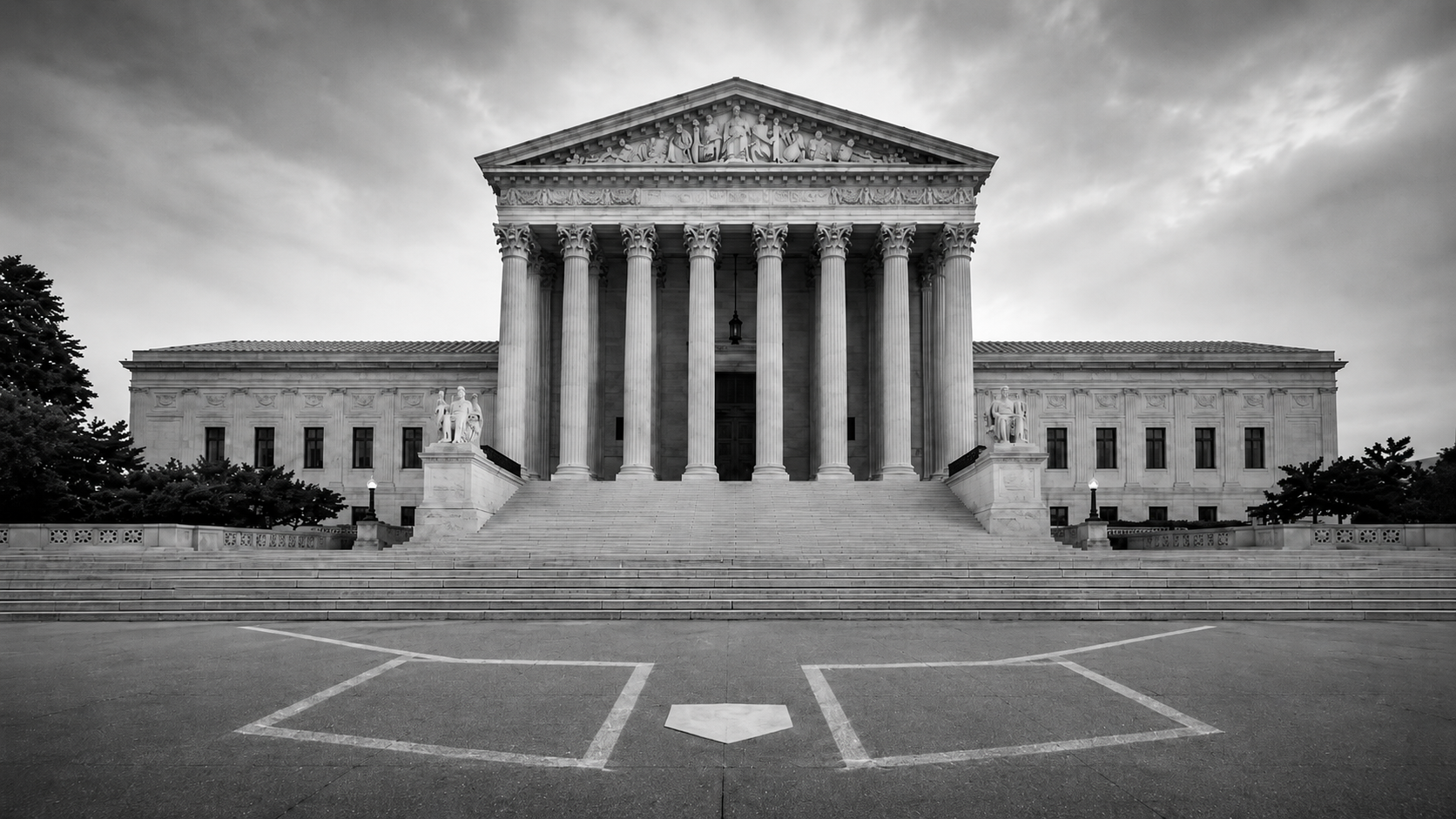
Chief Justice John Roberts was impressive at his confirmation hearing years ago. He looked the part, and regarding his subsequent SCOTUS rulings, he predicted, virtually promising, that he would be like the proverbial baseball umpire, merely “calling the balls and strikes,” and put-outs, one assumes. With few exceptions, has that been the way it’s worked out?
He said he’d just act as an objective observer, simply enforcing the rules of the game. He has emerged, however, as a baseball policy rule-maker, defining and redefining the strike-zone and other aspects of the game. So have the other justices appointed by Republican presidents, now making up SCOTUS’s “supermajority.”
Simultaneously, C.J. Roberts has been trying to convince us that he and other justices on the court are not Republicans or Democrats—that once appointed, they are merely non-partisan justices, still calling the balls and strikes. The evidence in recent major cases, especially the 6-3 cases, reflecting the party of the appointing POTUSes, doesn’t support that. Supermajority court rulings, past and present, suggest, if not prove, the same conclusion almost every time they rule thus. (Look back at the slaveowner-justices’ majority courts of the 1800s; see the anti-New Deal, Republican-majority court of the mid-‘30s, until pressured to change.) Closely divided courts tend to rule better, seemingly because compromise is required to attract a majority of votes. That tends to result in better argued opinions, for they must be accepted by all who support it. Supermajorities don’t have to compromise on anything, except within their majority. If they’re all also of the same religion, that predisposition may be even harder to resist.
If a justice writes and rules as we would expect “a Republican” to do, it hardly matters whether s/he calls her/himself one. For all useful purposes, isn’t s/he “a Republican”? (The same would be true of a Democrats acting similarly.) That seems especially the case of a justice who acted and/or still acts as “a Republican.” The chief justice needs to consider that perspective instead of merely parroting, “Justices are not party partisans.” Shouldn’t they be judged like the rest of us in that regard? Putting “Justice” before a name doesn’t baptize and so immunize her/him from partisanship. Non-partisanship is a status to be actively worked on throughout her/his time on the bench.
That particularly includes justices who attend partisan gatherings, speak at partisan meetings, and accept valuable gifts from partisans said to be “friends.” It doesn’t matter whether the events attracting their attendance are held at the White House or at far-flung vacation spots and whether they travel there on expensive private airplanes or ships or via gifts such as an expensive motorhome. Even Richard “I’m not a crook” Nixon would be forced to call “a crook” any justice violating such expectations, which should be flat-out prohibited by an enforceable SCOTUS Code of Conduct for Justices. Of all the officials in government, at all levels, local, state and federal, judges most particularly ought at least appear to be, if not actually to be, above reproach.
The almost 500 federal district judges are now held to high ethical standards; the nine on our nation’s highest court should be held to the highest ethical standards, because they make the rulings binding the others. After all, the confidence of the American people is their only real currency and they exercise in our democratic republic the most unalloyed power. It is ironically unacceptable that they are held to the lowest standards among the hundreds of federal judges. Yet, they keep making decisions reducing the Constitutional rights of women, African Americans, immigrants and, ultimately, of all of us, substituting their policy preferences for others’. In doing so, they are undercutting their moral authority to read the Constitution and statutes of our land in such unpersuasive ways. That their public polling approval rate has dropped to the lowest point in my lifetime should not surprise anyone. (The same has happened to the POTUS who appointed half of the supermajority.)
On top of that, they are now serving twice as long on average as justices 150 years ago, when a 15-year term was the norm, whereas other democracies term-limit their justices, ensuring that they are a part of their times, and represent here at least generally the constitutional thinking of the American people for whom they are stewards and guardians of the Constitution.
So, I say again, what I’ve said since POTUS 45 (now 47) and his then-majority leader inappropriately, perhaps unlawfully, appointed more than their share of SCOTUS justices in the former’s first term: We must restore balance to the court by: (1) Expanding its membership for the next other-party POTUS (giving that president at least three nominations to make up for the three the present one should not have had), (2) requiring 60 votes for ratification, (3) adopting an enforceable SCOTUS Code of Ethical Conduct, (4) limiting its terms to 20 years or the age of 75, whichever comes first, and (5) prohibiting any POTUS after the above from successfully nominating in any term more then two SCOTUS justices. If we don’t, we may meanly lose in our time, as Lincoln once warned, the heart and essence of our democratic republic through the Court’s anti-democratic rulings and self-interested posturing. These are the matters missing from the latest encomiums to the Court and POTUS.
In conclusion, permit me to add that I am not calling for these reforms merely because I disagree with some of the decisions of the Court over the past 20 years; I don’t expect ever to agree with all of its decisions. However, as a citizen-lawyer, I do expect to have and to maintain a high level of confidence in the Court, one more often than not closely divided on issues that divide the country so that decisions are persuasively argued by ethical, non-partisan justices, most of whom are held in high regard by the American people—justices who do not spend more than five POTUS terms on the Court.