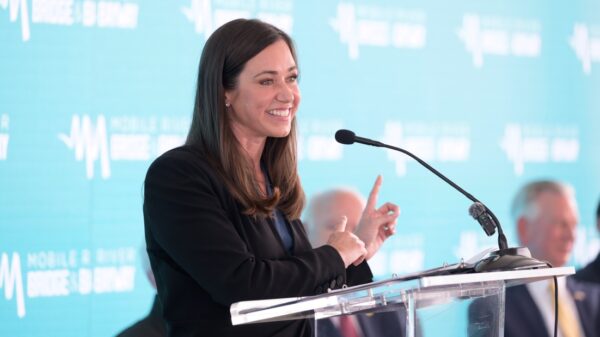





























U.S. Senator Katie Britt, R-Alabama, highlighted bipartisan legislation on Monday seeking to ensure the prosecution of individuals who produce sexually explicit content featuring children.
The Child Predators Accountability Act, was filed last month by U.S. Senator John Cornyn, R-Texas, with Britt cosponsoring the legislation alongside U.S. Senator Amy Klobuchar, D-Minnesota, and U.S. Senator Chuck Grassley, R-Iowa.
The bill would amend current law to clarify that a child’s passive engagement in sexually explicit content violates federal law.
“From day one, I have intended to serve in Congress as a voice for the voiceless and protect the most vulnerable among us—our children,” Britt said.
“This bipartisan effort would help ensure no child predators slip through the cracks and that justice is served to these heinous individuals,” the senator added. “I’m tremendously grateful for my colleagues’ leadership on this, and I look forward to working with them to get this signed into law.”
Bill sponsors cited the U.S. Seventh Circuit Court of Appeals’ ruling in United States v. Howard as prompting the legislation.
The case was brought against Matthew Howard of Madison, Wisconsin, who was arrested in August 2017 on suspicion of possession of child pornography. A large amount of child sexual abuse material was subsequently found on Howard’s computer by law enforcement, and he was charged with seven crimes related to the possession, distribution and production of child pornography.
Howard pleaded guilty to five of the charges and went to trial for the remaining two counts. His legal team argued that videos Howard made of himself performing sexual acts in the same room as his nine-year-old niece, who was asleep and fully clothed, did not constitute a violation of the statute he was charged with.
A jury found Howard guilty of the two charges. However, the Seventh Circuit later vacated his conviction on the contested counts.
The court wrote that the state’s interpretation of the child pornography law that Howard was found guilty of violating “stretches the statute beyond the natural reading of its terms considered in context,” as his niece did not engage in sexual conduct under the statute’s definition.
Britt’s office argued that the verdict “sets up a dangerous legal precedent and threatens prosecutions for offenders who film sexually explicit content of minors when they are sleeping, drugged or otherwise unconscious.”
“The Child Predators Accountability Act would address this discrepancy, clarifying that the passive engagement of a child in sexually explicit conduct violates federal law,” the senator’s office wrote.
The Child Predators Accountability Act would specifically amend the definition in Title 18, Section 2251(a), of the U.S. Code of engaging in sexually explicit conduct.
The bill would clarify that illegal depictions of a minor engaging in sexually explicit conduct may take the form of “the depiction of the minor in the visual depiction of the sexually explicit conduct, regardless of whether the minor participated in such conduct, if the defendant intentionally included such minor in the visual depiction.”
The legislation has seen endorsements from the nonprofits Raven, the National Children’s Alliance and Rights4Girls, alongside the National District Attorneys Association, the Association of State Criminal Investigative Agencies and the Major Counties Sheriffs Association.
“Congress must protect children from abuse and ensure all predators are held accountable for their disgusting crimes,” Grassley said of the bill. “By closing this legal loophole, the bipartisan Child Predators Accountability Act makes clear that child exploitation will never be tolerated, and anyone who uses children in any sexually exploitative context will face justice.”
Britt’s office, which described the senator as “a leading voice in working to protect America’s youth,” highlighted multiple pieces of legislation she has previously sponsored or endorsed aimed at protecting minors against online sexual exploitation.
This includes the Kids Off Social Media Act, which would set a minimum age of 13 for social media users and prevent algorithmically targeted content for users younger than 17.
The senator’s team also pointed to Britt’s carrying of the Stop Sextortion Act, which would target individuals who threaten to distribute child sexual abuse material, and her support for the TAKE IT DOWN Act, sponsored by U.S. Senator Ted Cruz, R-Texas, which criminalizes the dispersal of non-consensual intimate imagery and was signed into law last year.
The Child Predators Accountability Act has been referred to the Senate Committee on the Judiciary to undergo review.
A U.S. House version of the legislation, filed last year and sponsored by U.S. Representative Mark Harris, R-North Carolina passed in the House in January.