

















The question that has been asked most often since Tuesday night’s primary election is probably not the best question.
Coming into this election cycle, with the prospect of Doug Jones facing Tommy Tuberville to become the state’s next governor looming out there, it is only natural, I suppose, that that race would be all consuming when we finally got it. So, naturally, the question on many people’s minds come Wednesday morning was: Does Jones have a realistic shot to beat Tuberville?
Yes is the answer.
And the reason that answer is yes could best be answered by answering the more important question: What did those voter turnout numbers tell us about this election cycle?
The short answer to that question: Democrats are surging and Republicans are faltering.
Compared to the 2022 and 2018 midterm election cycles, the 2026 showing for Alabama Democrats was nothing short of remarkable. They essentially doubled their number of voters taking the Democratic ballot (you can’t vote in both primaries in Alabama) and did so despite not having particularly compelling primary races up and down the ballot.
Republicans, in the meantime, had a new gubernatorial candidate for the first time in a decade, highly competitive and visible races at the top of the ticket and numerous down-ballot contests that drew interest. And they lost about 200,000 votes from 2022.
(And this doesn’t consider the higher-than-usual number of voters who would choose Democrats in a general election but chose to vote in the Republican primary because there were more competitive races on that ballot.)
That is very problematic for Republicans. In fact, it has the potential to be a seismic shift in voting for the state, depending on what happens from here.
Let me explain before anyone gets carried away. When there is a one-party state, such as Alabama, the cause for that is typically built on two things: Money and rhetoric. Mostly money.
Alabama is Republican dominated currently because Republicans dominate the money. Businesses like stability. They’ll accept a change if a change is inevitable, but ideally, they like being able to plan, to know who they’re dealing with, to set up long term relationships with the folks who are making decisions. And they don’t want to risk angering those folks in charge. That’s why they routinely toss money into the coffers of Republicans in this state, and into the coffers of Democrats in blue states.
There’s also the matter of rhetoric—where the party in control does a good job dirtying up the other party in the eyes of voters. For years now, in Alabama, many voters have used Democrat as almost an insult. That’s because of the rhetoric.
But right now, Alabama Republicans are teetering on the edge of a big cliff. They have tied themselves to national politics and to the cult of Donald Trump so thoroughly that it is impossible to separate them. So goes the nation, so goes the Alabama Republican Party.
And the nation ain’t going so swell.
High prices, war, the Epstein debacle, job losses, just outright campaign lies and utterly bizarre comments from Trump have Americans, including a bunch of people in Alabama, angry and frustrated. You’ve seen it all over the country in elections, and Alabama was no different.
Trump keeps taking victory laps for getting his preferred candidates elected in primary races, but those races all have one thing in common—extraordinarily low turnout for Republicans. Which tells us one thing: While that MAGA base is showing up to vote, more traditional Republicans and moderate conservatives are looking elsewhere.
And realistically, there’s only one place to look.
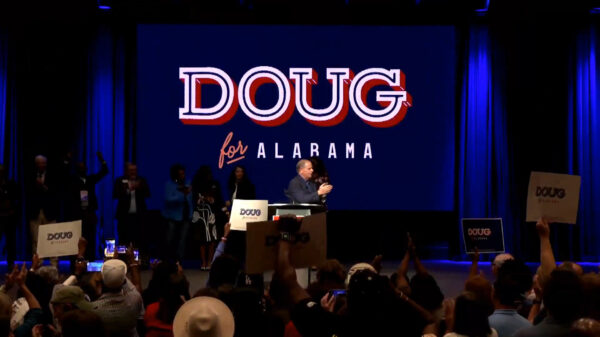
To their credit, Democrats, even in Alabama, are taking advantage of the opportunity. They have been quick to offer solutions to pressing issues and have been unusually organized in their pushback against Trump and his blatant corruption. They’ve also put together their best Alabama ticket in more than 15 years.
That’s pushing people to vote for Democrats. That’s pushing businesses to consider, for the first time in a long time, that maybe the Democrats are the safer, more stable option.
And once you start down that pathway, it’s hard to turn the train around.
Now, am I saying that there’s about to be a monumental shift to Democrats running things? No. Not at all. I’m not even saying that there’s going to be a shift significant enough to break the Republican supermajority in the near future.
What I am saying is that all of a sudden, Democrat isn’t such a dirty label and the party isn’t the butt of jokes.
And that’s why Doug Jones has a chance against Tommy Tuberville.
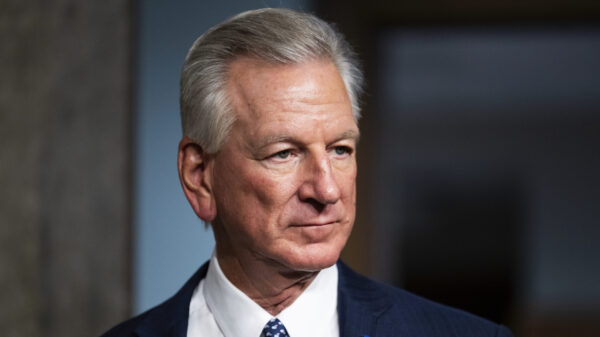
Because no candidate is more tied to Trump and Trump’s policies than Tuberville. No candidate has been more polarizing. And no candidate is more disliked by moderate Republicans than Tuberville.
The question, though, rests with the raw numbers. Are there enough disenchanted traditional Republicans—or will there be on November 3—and will the ongoing fight around voting rights and redistricting produce a large enough uptick in new voters to push Jones even with Tuberville?
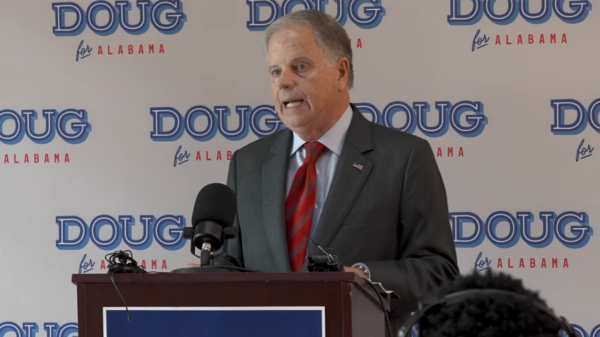
For his part, Jones is making this a hard decision for those moderates. He held a press event on Wednesday with Kentucky Governor Andy Beshears, a Democratic governor of a red state who has experienced great success and won over the moderates in that state.
Jones is the same kind of centrist Democrat. He proved that during his time in the U.S. Senate, where he was one of the country’s most bipartisan lawmakers. And one of its most successful at getting legislation passed, thanks to his willingness to work across the aisle and take the job seriously.
Now, combine Doug Jones, the stable, trusted candidate, with the national climate, the unpopularity of Trump, the polarization of Tuberville, the ongoing voting rights upheaval and the disenchantment of moderate Republicans.
That’s a good soup for Democrats.