













An Alabama House committee advanced legislation on Thursday to allow new special primary elections if federal courts lift injunctions on Alabama’s state Senate map.
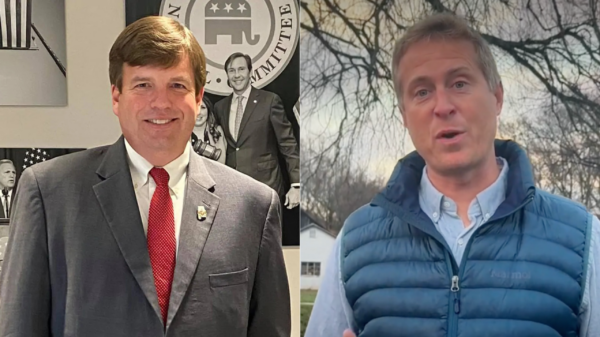
Senate Bill 1, sponsored by Senator Chris Elliot, R-Josephine, would allow special primaries to be held in state Senate Districts 25 and 26, should the 11th Circuit Court of Appeals lift injunctions barring the state from using a state Senate map proposed in 2021 that was found to have diluted Black voting strength in the Montgomery area.
The court mandated that Alabama adopt its current state Senate map, which includes two Black opportunity districts in the Montgomery area.
Following the Supreme Court’s ruling in Louisiana v. Callais, Alabama Attorney General Steve Marshall and Secretary of State Wes Allen appealed to the 11th Circuit to have the injunction revoked. The pair has petitioned the U.S. Supreme Court to do the same, regarding its verdict in Allen v. Milligan, which struck down the state’s 2023 congressional map for underrepresenting Black voters.
The House Ways and Means General Fund Committee ultimately voted 11-4 to advance the legislation during its Thursday meeting.
During the committee meeting, state Representative Napoleon Bracy, D-Saraland, asked Representative Chris Pringle, R-Mobile, the bill’s House sponsor, to describe why he felt the legislation was needed and whether the bill was in response to the Callais verdict.
“Is this another ‘if’ bill?” Bracy asked.
“The court has to remove its injunction. Yes,” Pringle responded.
Pringle described the Supreme Court ruling in Callais as revoking the need for Alabama’s current court-drawn map, which he argued was an instance of racial gerrymandering. The representative called for the state to return to its Legislature-drawn 2021 state Senate district map, which was struck down by the 11th Circuit if the court injunction is removed.
“It is the contention of the state of Alabama, and our appeals, that the court engaged in a flagrant racial gerrymander when they drew these two new Senate districts, and the Louisiana [case] outlawed racial gerrymandering,” Pringle said.
Bracy, however, pointed to Amendment 4 to the Alabama Constitution of 2022, which holds that laws regarding elections cannot take effect within six months of a general election, citing that May 3 is the last day the state is eligible under the amendment to enact measures such as SB1.
“We are within six months of a general election, which will also violate the very Alabama Constitution that we have that the citizens of Alabama voted in 2022 and ratified,” he said. “We’re now defying the own rule that we put in place.”
“I just want to let you know, if this bill passes, we gonna file for a declaratory injunction against this because you are violating the Fourth Amendment,” Bracy told Pringle.
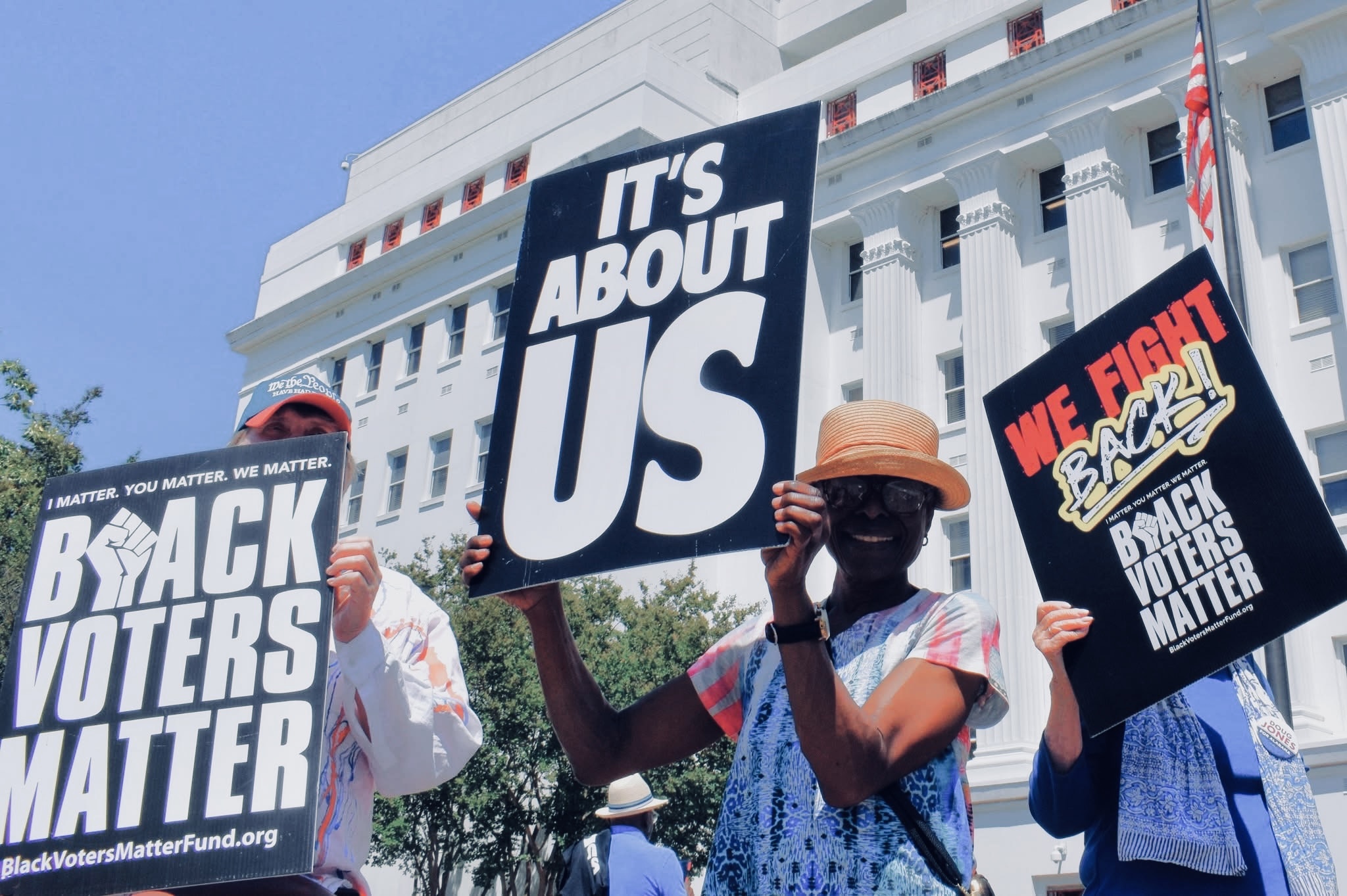
During a public hearing on the bill, all speakers who appeared voiced opposition to the legislation.
A’Niya Robinson, policy director for the ACLU of Alabama, recounted the first time she visited Montgomery, when forced to evacuate from New Orleans during Hurricane Ida.
Robinson recalled receiving compliments from a cashier she met in the city and receiving a free meal from a waitress after telling her she had been forced to flee Louisiana.
“Those are the people of Senate Districts 25 and 26. They are decent, good and hard working,” she said.
“In the proclamation, it discusses nothing about the maternal health care that would have helped that cashier or a minimum wage that would have helped that waitress,” Robinson said of SB1. “Instead, this bill is essentially throwing their votes out and telling them to start over. And so, the ACLU of Alabama, we cannot, in good conscience, stand in support of a bill that disenfranchises people and causes chaos.”
Letetia Jackson, a plaintiff in the case that struck down Alabama’s proposed 2023 congressional map, Allen v. Milligan, similarly described the legislation as an attempt to silence Black voters.
“It seems I’ve been fighting for fair representation my whole life. I am asking the committee to vote no on this bill,” she said. “However, I don’t think anything that I say is gonna change hearts and minds, especially those intent on denying Black Alabamians’ fair representation.”
Pastor Richard Williams of Montgomery’s Metropolitan United Methodist Church, in his remarks, told the committee, “When the wicked breed the rules, the people mourn.”
“Scripture reminds us that leadership matters. Who governs matters. The decisions of leaders affect the joy and safety in the future of our community,” Williams said. “Think about a traffic light. Red means stop. Green means go. Now, imagine if nobody has agreed upon the rules. That’s why I think we’re here, because clearly, I don’t think we know that the red light means to stop.”
Dev Wakeley of Alabama Arise told the committee, “This body has been terrible to Black voters.”
“The next special session I want to see is a special session that is called to advance democracy, and not to put a thumb on the scale for power structures that have already had every benefit, and every effort taken by this body to bend over backwards for them,” he said.
“You are hearing Black voters tell you now that this bill will be bad for them. And I urge you to listen to the Black voters who are coming to you to ask for a fair shake,” he added.
Adding to Wakeley’s comments, Representative Mary Moore, D-Birmingham, accused the state Legislature of hindering Black lawmakers as well as voters.
“They have put so many rules in that it is even difficult for us to argue for our own citizens,” Moore said. “So, it’s not only the citizens, but the citizens’ representatives that they have mistreated.”
“Anglos did not discover this country first. But you raped, and you pillaged, and you stole from the people that was already here,” she continued. “But it’s a sad thing that you think that you have to rule. And that’s not gonna work, not under God’s heaven, it’s not gonna work.”
Representative Jaundalynn Givan, D-Birmingham, described the legislation as “plantation politics at its best.”
“It is ridiculous what we’re doing here today,” she said. “I’m not here to call you and ask you to not vote. I’m here to reveal how you vote.”
DayShawn Goodwyn, a junior political science major at Tuskegee University, argued SB1 would deepen young Alabamians’ distrust of and disengagement with their government.
“These proposals risk silencing growing communities, especially Black voters—young voters in urban communities, whose perspectives deserve equal representation,” he said. “We deserve a political system that values, fairness, and transparency, not one designed to preserve power for a select few.”
Aliya Purnell, a sophomore political science major from Tuskegee University, told the committee that she moved to the state from California because she “believed in Alabama’s promise.”
“This issue is not abstract. It concerns Alabama’s future and your commitment to equal representation,” Purnell said. “If our representation is removed, students like me will face broken promises, lost scholarships and reduced resources. Our aspirations will be dismissed, and Alabama’s commitment to fairness will be compromised. The entire country is watching us to see how we will deliberate.”
Chastity Player, a Tuskegee student and former statehouse intern, described SB1 as attempting to return the state to a map that federal courts have already found to have “intentionally weakened Black voting power across this state.”
“It is sad that in 2026, we are still having a fight for equal rights and equal voting power,” she told the committee.
Ja’Kobe Bibbs, a rising senior at the University of Alabama, urged the committee to consider the remarks of the three students who spoke before him.
“I stand before you today, not just as a student, but as a young Black voter who is tired of watching the voices of communities, like mine, treated as negotiable,” he said. “I came here because I believe that democracy only works when every person believes their vote matters equally. And right now, across Alabama, many people are beginning to question whether that promise still exists.”
Dr. W. Taft Harris Jr. of Black Lives Matter Grassroots and the Tabernacle Fellowship of Birmingham strongly condemned SB1 and Republican calls for redistricting.
“It has, once again, been confirmed in the state of Alabama, that the garments of segregation, disenfranchisement, racism and evil are still stylish and fashionable,” Harris said. “We are here again because the tips of your hoods have once again signed off on legislation that fractures the political skull of Black folk.”
“We say to you, if we have to meet you at Edmund Pettus Bridge again, we will meet you there,” he added.
Harris led attendees in chants of “No justice, no peace,” which briefly interrupted the committee’s public hearing.
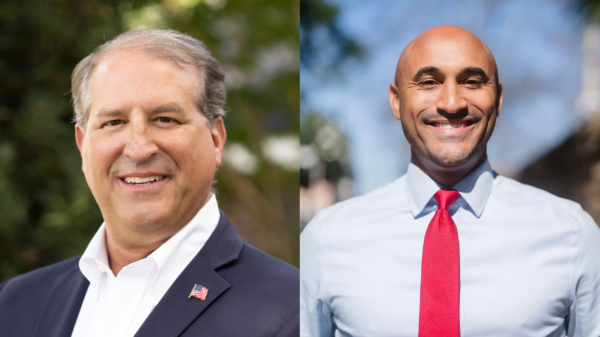
The hearing’s final speaker, U.S. Representative Shomari Figures, D-Alabama, who gained election following the state’s adoption of maps mandated by Allen v. Milligan highlighted that Black opportunity districts, such as his own and those the Legislature is focusing on in Montgomery, are not majority-minority districts, and argued such districts are necessary to ensure Black voters have a voice.
“The greatness of this nation is the possibility of what we can’t be in the future. And we’re in a place now where we have opportunities for fair representation,” the representative said. “This is not about stacking the deck. This is not about a fixed outcome. This is not about a promise nor a guarantee. This is about an opportunity. All we ever wanted was an opportunity.”
“We have to make sure that we maintain that legitimate opportunity. We have to make sure that we continue to go down the path of progress and not go backwards,” he added.
“We cannot go backwards,” Figures said. “Black people have done too much for this state, too much for this country, too much for this nation to say that you don’t get a voice, to say that you can’t be heard, to say that you don’t have a legitimate opportunity.”
Following the public hearing, SB1 received further criticism from Bracy and fellow Democratic committee members Representative Laura Hall, D-Huntsville, Representative Pebblin Warren, D-Tuskegee and Representative A.J. McCampbell, D-Demopolis.
The committee’s vote on the measure ultimately split along racial and party lines, with each Republican on the committee, all of whom are white, voting in SB1’s favor. Each of the committee’s four Black Democrats voted against the bill.
SB1 will now advance to the Senate floor for a vote.