



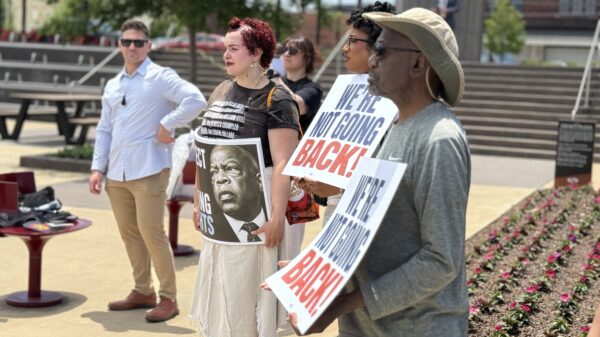











A new report has found that more than 815,000 Alabamians—roughly 21 percent of the state’s voting-age population—do not regularly participate in elections.
The report, entitled “Missing Voters: The Real Threat to Alabama’s Democracy,” was published by Stand Up Mobile, the Southern Leadership for Voter Engagement Network, and Dēmos, a national nonprofit public policy organization. The authors argue that structural barriers–rather than voter apathy or indifference–are responsible for driving a significant number of Alabamians away from the ballot box.
“More than 800,000 Alabamians are missing from our elections, and that should concern all of us,” said Beverly Cooper, co-founder of Stand Up Mobile. “But this report also gives us something just as important—a clearer understanding of what people are facing and what we can do about it.”
“When we listen to people’s stories and remove the barriers in their way, we have an opportunity to grow the field and build a democracy where everyone has a voice,” she added. “That kind of change is possible.”
According to the report, around 300,000 of Alabama’s 815,000 “missing” voters are unregistered. Many of these unregistered voters mistakenly believe that they are already registered while others are simply unaware of how or when to register to vote. Without automatic voter registration or even same-day registration available in the state, these Alabamians end up losing access to the ballot box.
The remaining 515,000 “missing” voters in Alabama are registered to vote but are considered “inactive voters.” These residents are eligible to vote, but must complete a reidentification form at their polling place before they can cast a ballot—a barrier which the report’s authors say can discourage individuals from exercising their right to vote.
Young voters in Alabama remain underrepresented in the electorate, with only 55 percent of voters aged 18 to 25 being registered to vote, compared to 78 percent of those aged 66 or older.
Latino voters
Alabama’s small but growing Latino population is disproportionately underrepresented in the electorate, with only 30 percent of Latino Alabamians being registered to vote. The authors suggest that this reality may arise from structural barriers, including a lack of election materials translated into Spanish.
“We have a system that creates barriers to entry for voter registration for people who do not look or sound white, [or] if you don’t speak English,” said Carlos Javier Torres, director of policy and strategic partnerships at the Hispanic and Immigrant Center of Alabama. “The system has actually ingrained [this] into their process… as a way to keep us from engaging in the civic process of voting.”
Inactivity rates
Black voters have higher inactivity rates than white voters in all but four counties in the state (Jefferson, Mobile, Montgomery and Lee). Statewide, 14.9 percent of Black voters are inactive compared to 12.7 percent of white voters, again demonstrating the disproportionate underrepresentation of minorities in Alabama’s electorate.
Alabama’s aggressive “list maintenance” approach in which voters are regularly purged from the state’s voter rolls can also make it more difficult to vote. An Alabamian can have their registration effectively revoked if they fail to respond to the two-part mailing process and do not participate in any election during a four-year election cycle.
Those affected can still vote, but must jump through further bureaucratic hurdles to do so. In 2025 alone, nearly 500,000 people were removed from Alabama’s voter rolls through this process, disproportionately impacting low-income, Black, brown and rural voters.
Felony dienfranchisement
The authors also note that Alabama has one of the highest felony disenfranchisement rates in the country, barring over 220,000 Alabamians from voting as of 2024, including over 82,000 Black residents and over one percent of the state’s voting-age female population.
The report suggests that the state’s “moral turpitude” standard used in making disenfranchisement determinations is intentionally vague, allowing officials to selectively target Black voters over time by applying the standard to crimes Black voters are stereotypically assumed to commit, while exempting crimes more commonly associated with white residents.
“The 1901 Constitution was written amid a resurgence of white supremacist laws across the South, and this [moral turpitude] provision was one of many that laid the groundwork for Jim Crow laws and practices that have continued to plague Alabama,” the authors write.
Disabilities
Alabamians with disabilities face structural barriers when attempting to vote. Even though nearly one in three adults in Alabama reports having a disability, the state lacks sufficient accommodations to help those with hearing, physical, cognitive or other accessibility needs to cast their ballot.
The authors cite data from a 2024 U.S. Census Bureau report in which 26 percent of nonvoters in the state reported that they did not vote due to “Illness or disability (own or family’s)”—double the national rate of 13 percent.
“With a ban on curbside voting, no early voting options, and a convoluted process for those with disabilities to vote by mail, it is unnecessarily hard for far too many people in Alabama to easily exercise their right to vote,” said Sarah Ovaska, senior communications strategist at Southern Coalition for Social Justice. “Alabama should adopt more voting options without delay, so that every person can have a say in the future of their communities.”
Solutions
To address Alabama’s low voter turnout and drive more Alabamians to the ballot box on election day, the authors conclude the report by providing several policy recommendations for state lawmakers.
Specifically, the authors suggest that Alabama should adopt policies that give residents more flexibility with how, when and where they can cast their ballots—policies like early voting, same-day and automatic voter registration, no-excuse absentee voting and ballot drop boxes.
The authors also support ending felony disenfranchisement, eliminating unnecessary ID barriers, expanding language access and accessible voting options, limiting law enforcement presence at polling locations to true emergencies, and ensuring transparency and equity safeguards for polling place changes.
Many of these proposed changes are included in the Alabama Voting Rights Act, a proposed piece of legislation that looks to expand voting access and prohibit voter suppression in the state. However, both the House and Senate versions of the bill failed to make it out of their respective houses of origin during the 2026 Legislative Session.
“It’s no accident that these barriers to the ballot box have affected so many Alabamians—many were specifically designed to close the door on voters of color and low-income communities,” said Keshia Morris Desir, associate director of Democracy at Dēmos. “All voters deserve to have an equal say. Alabama lawmakers should adopt policies that expand and empower the electorate, as laid out in the report, rather than shut out their voices.”