
















Under a standing federal injunction stemming from Allen v. Milligan, Alabama is required to use a court-drawn congressional map until 2030.
That order is still in place.
And now, a new filing is asking whether the state is trying to move around it.
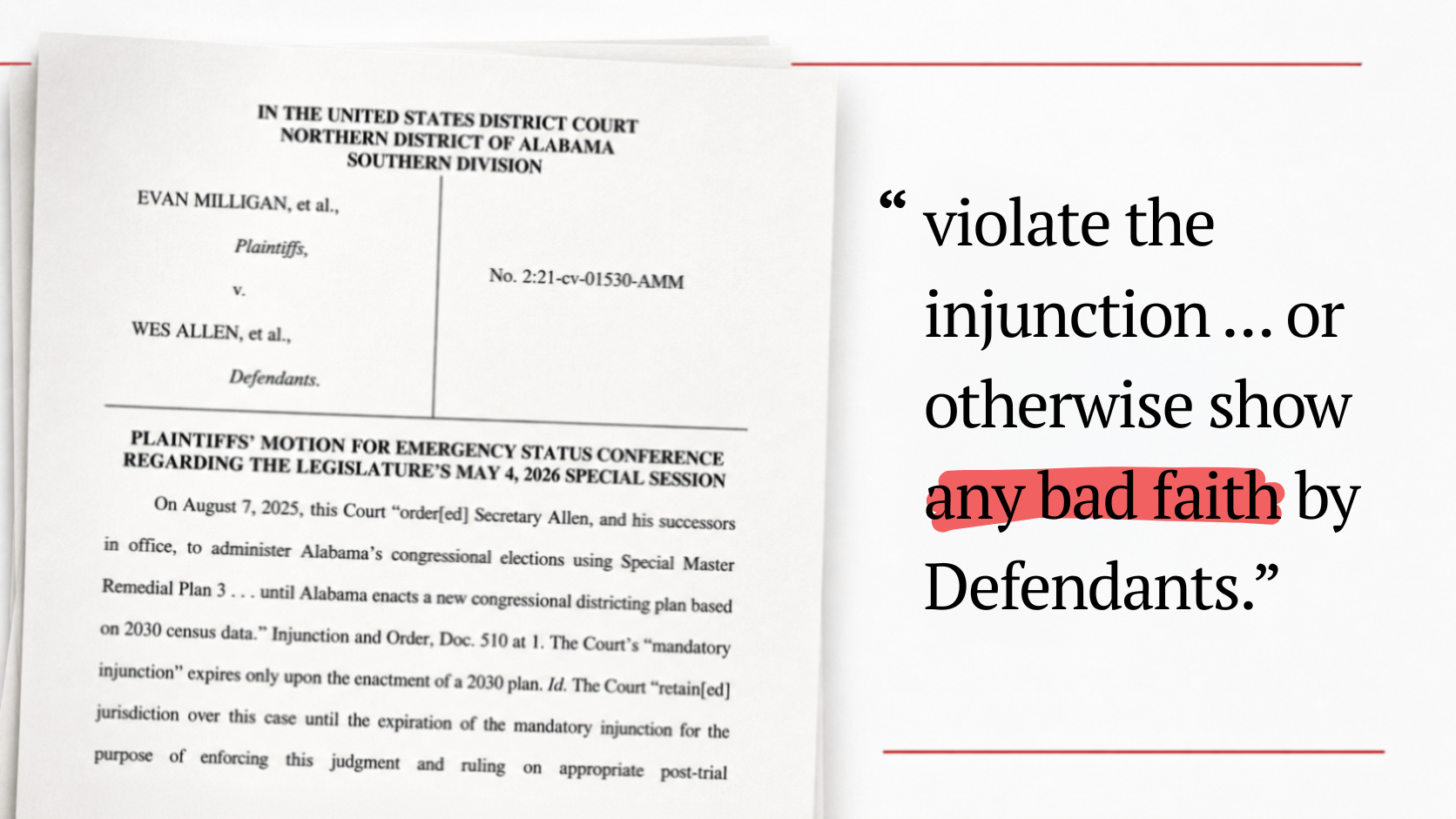
On Monday, plaintiffs including Evan Milligan, along with the Caster and Singleton plaintiffs and the NAACP Legal Defense Fund, requested an emergency status conference following Governor Kay Ivey’s call for a special legislative session tied to congressional elections.
They are not alleging a direct violation. Not yet.
But they are asking whether the state’s actions “violate the injunction or … otherwise show any bad faith.”
That question lands differently because of what the state previously told the court.
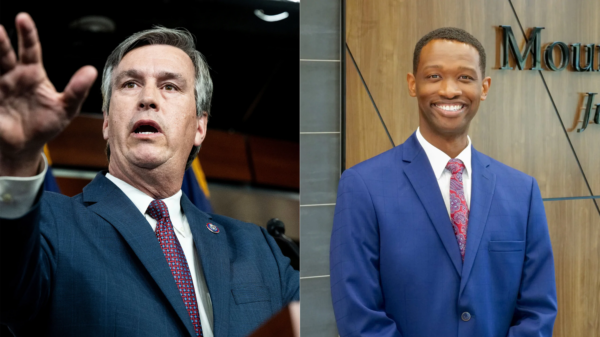
During the course of the litigation, state legislative leaders—including Senator Steve Livingston and Representative Chris Pringle—represented “in good faith that neither they nor leadership for either chamber of the Alabama Legislature have any intention of passing any additional congressional district maps before receiving 2030 census data.”
The court relied on that. It mattered.
Because federal courts do not operate on orders alone. They rely, in part, on the credibility of the parties before them. When a state defines the limits of its own actions, and the court accepts those limits, it becomes part of the framework of the case.
Now, that framework is under pressure.
The Legislature has been called into special session to consider legislation providing for elections in districts “altered by a court issuing a judgment, vacating an injunction, or otherwise ordering” changes.
It is a legal positioning strategy designed to preserve options the state told the court it would not pursue. Alabama is positioning itself for the moment the law changes.
And that moment may be closer than it once appeared.
Allen v. Milligan forced Alabama into compliance with the Voting Rights Act.
Louisiana v. Callais signaled that the scope of that compliance may not hold.
In Callais, Justice Samuel Alito insisted the Court had “not overruled Allen.” But the majority also declared that “race and politics must be disentangled” and warned that if Section 2 claims are used “as a tool for advancing a partisan end, the VRA’s noble goal will be perverted.”
This is not happening in isolation. In the days following Louisiana v. Callais, President Donald Trump has urged Republican-led states to revisit their congressional maps ahead of the midterms, encouraging governors to redraw districts and praising efforts to alter election timelines tied to redistricting.
There is little immediate legal upside for Alabama in acting now. The injunction remains firmly in place. The path to changing the map before 2030 is uncertain at best.
Which raises a more direct question: What is the state trying to accomplish?
Privately, some Republicans acknowledge the tension. They describe efforts like this less as a realistic path to immediate change and more as a response to that pressure—a signal that the state is aligned with a broader national push, even if the outcome in Alabama itself is unlikely to shift in the near term.
If that is the case, the implications are significant.
Because the issue before the court is both compliance and whether the court’s own authority can be shaped—or limited—by representations that may no longer hold.
The plaintiffs’ motion puts that question squarely before the judges, asking whether the state’s actions are consistent with its prior commitments or whether they reflect a change in posture that warrants closer scrutiny.
To be clear, Alabama has not crossed the line. The current map remains in effect. Elections will proceed under it unless a court says otherwise. But the line is no longer static. It is being approached.
Redistricting has become a national contest for power—shaped by court rulings, political pressure, and a looming midterm—the meaning of that line matters as much as its location.