



























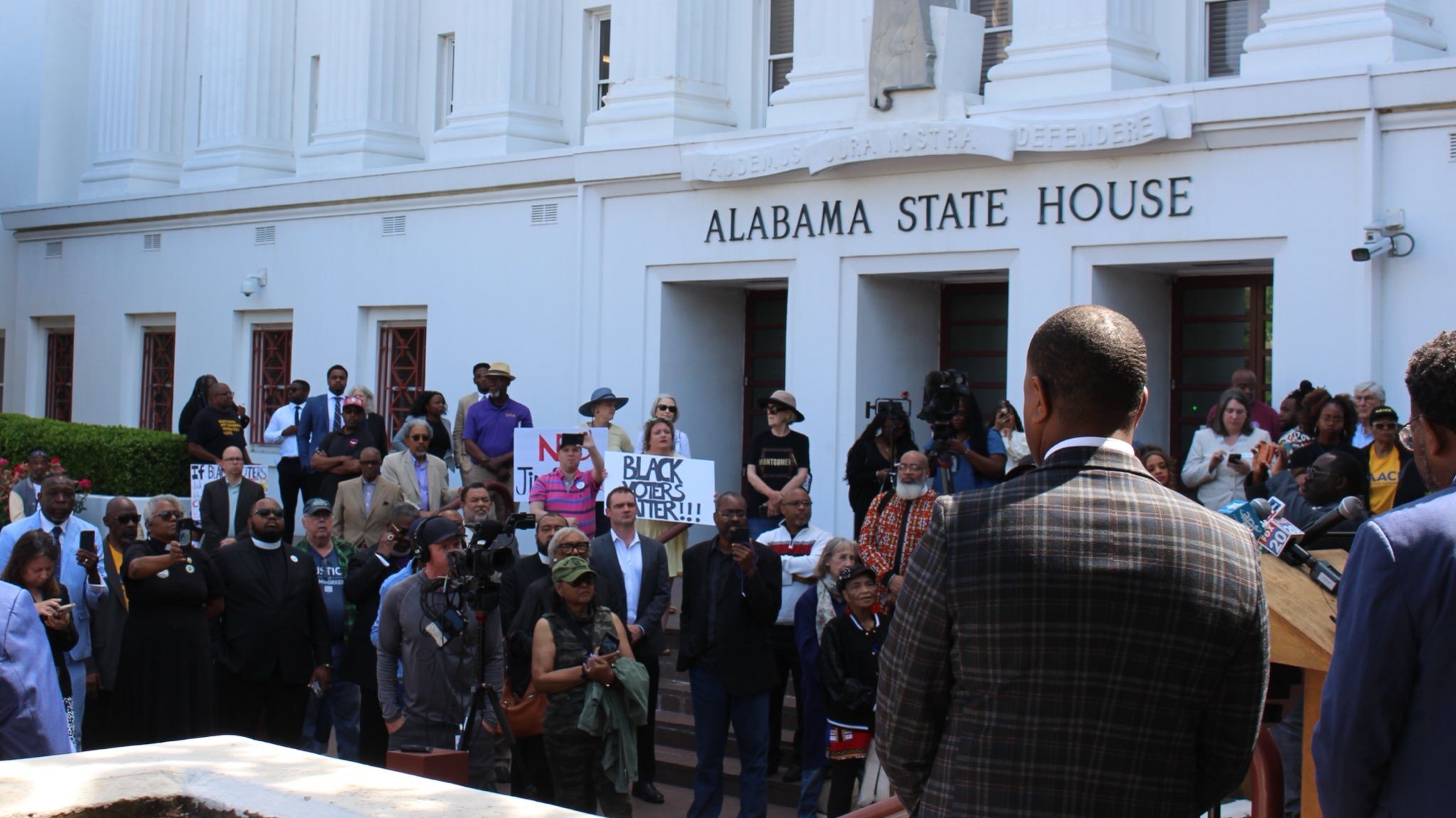
The Alabama Senate Fiscal Responsibility and Economic Development Committee on Monday advanced Senate Bill 1, sponsored by Representative Chris Elliott, R-Josephine, after a lengthy and often emotional public hearing that put on display the divisions over redistricting, election timing and the state’s history with voting rights.
The bill would establish a mechanism to hold new special primary elections in certain state Senate districts if ongoing federal litigation changes district lines in Senate District 25 and SD26. Supporters say the measure is a necessary contingency plan in the event federal courts overturn court-ordered maps currently governing several districts. Opponents argue it is premature and potentially in conflict with voter-approved constitutional protections.
Jerome Dees, Alabama policy director for the Southern Poverty Law Center, reminded the committee that the remedial Senate districts ordered in Stone v. Allen remain in effect.
“This legislation is built entirely on speculation,” said Dees. “Speculation that Alabama will prevail in ongoing federal litigation, speculation that existing court-ordered district lines will be overturned, and speculation that voters should be asked to endure electoral disruption.”
Dees warned that proceeding now would send “a troubling message” that the legislature views court orders as “temporary inconveniences rather than binding legal directives.”
The hearing frequently returned to Amendment 4, a 2022 constitutional amendment approved by roughly 80 percent of Alabama voters that bars election-related legislation from taking effect within six months of a general election.
Senator Rodger Smitherman, D-Birmingham, questioned whether SB1 violates either the letter or the spirit of that amendment.
“What are the justifications for disregarding Amendment 4? We passed Amendment 4. It prohibits a change in election dates, something Alabama voters approved by an 80 to 20 margin back in 2022. Yet here we are ignoring the will of the people.”
Tabitha Isner, the only Democratic candidate running in Senate District 26, spoke from personal experience about the impact of shifting lines.
“I’ve been running in Senate District 26 in Montgomery and Elmore for four months now,” said Isner. “I’ve been knocking on doors. I’ve been calling voters. I’ve been making great efforts for four months now in Montgomery and Elmore—not Montgomery and Crenshaw.”
Isner said the biggest challenge she faces is simply helping voters understand where their district is. She described the broader civic impact of frequent changes.
“Our job, as representatives of the people, is to help the people understand how their government works and help them be part of government working well. That’s democracy,” said Isner. “It’s kind of a beautiful thing. It’s kind of a radical thing, this idea that people get to have a say in their government. But it is so confusing.”
Isner also pushed back on assertions that the issue is purely partisan.
“I heard Lieutenant Governor Ainsworth say that this is a Republican state and it should have Republican representatives,” said Isner. “But I want to clarify for you, that’s not true in any number of ways.”
Democratic members of the committee offered several amendments aimed at softening or modifying the bill. One amendment, offered by Senator Vivian Figures, D-Mobile, would have strengthened public notice requirements, ensuring they were “provided in a manner reasonably calculated to inform affected voters,” directing the Secretary of State and county officials to provide clear notice of election date and polling place changes through websites and postings at affected locations.
“This is a very simple amendment,” said Figures. “People need to know, and they need to know ahead of time where they’re going to vote. We’re talking about people’s right to vote.”
Elliott declined to accept the proposal as a friendly amendment, saying he wanted more time to review it and consult with election officials. The amendment failed on a roll call vote along party lines.
A second amendment, offered by Senator Merika Coleman, D-Pleasant Grove, sought to replace the word “shall” with “may” in a provision requiring the state to hold a new special primary election, thereby giving officials discretion rather than imposing a mandate.
“All it does is give the state some flexibility,” said Coleman. “It gives discretion. And that’s all I’m asking—to give the state discretion to actually follow the law.”
Elliott opposed the change, saying it would “fundamentally change the bill.” That amendment also failed on a roll call vote along party lines.
Another amendment, offered by Senator Kirk Hatcher, D-Montgomery, would have restored runoff elections if no candidate received a majority in a special primary. Hatcher, offering the amendment, pointed out that eliminating runoffs would deprive voters of a full and fair choice.
“What I’m attempting to correct is that there would be a runoff,” said Hatcher.
The sponsor declined to accept that amendment as well, citing timing concerns and constraints. It too failed on a roll call vote along party lines.
By the end of the hearing, SB1 had advanced out of committee.