




















Alabama voters did something Tuesday they rarely do in large numbers.
They made incumbency look less like protection and more like exposure.
Across the state, veteran lawmakers, longtime officeholders and politically established candidates fell in one of the most volatile Alabama primary elections in recent memory. By the end of the night, at least 10 incumbents had lost their primaries, including two state senators, multiple House members, a Public Service Commission commissioner and a member of the State Board of Education.
The defeated incumbents included eight Republicans and two Democrats, underscoring that Tuesday’s anti-incumbent mood was not confined to one party. Republicans Jeremy Oden, Public Service Commission Place 1; Marie Manning, State Board of Education District 6; Senator Dan Roberts, R-Mountain Brook; Senator Greg Albritton, R-Atmore; Representative Phillip Pettus, R-Killen; Representative Greg Barnes, R-Hamilton; Representative Jim Carns, R-Vestavia Hills; and Representative Matt Simpson, R-Daphne, all lost their primaries. Democrats Representative Kelvin Datcher, D-Birmingham, and Representative Juandalynn Givan, D-Birmingham, also fell.
That matters.
Because these defeats do not fit neatly into one ideological narrative.
Some of the incumbents were reliable conservatives. Others were viewed as more moderate or institutional. Some were outspoken fighters. Others were quieter lawmakers who worked the committee rooms, built relationships and tended to the daily mechanics of state government.
But on Tuesday, many of the old protections of Alabama politics failed them.
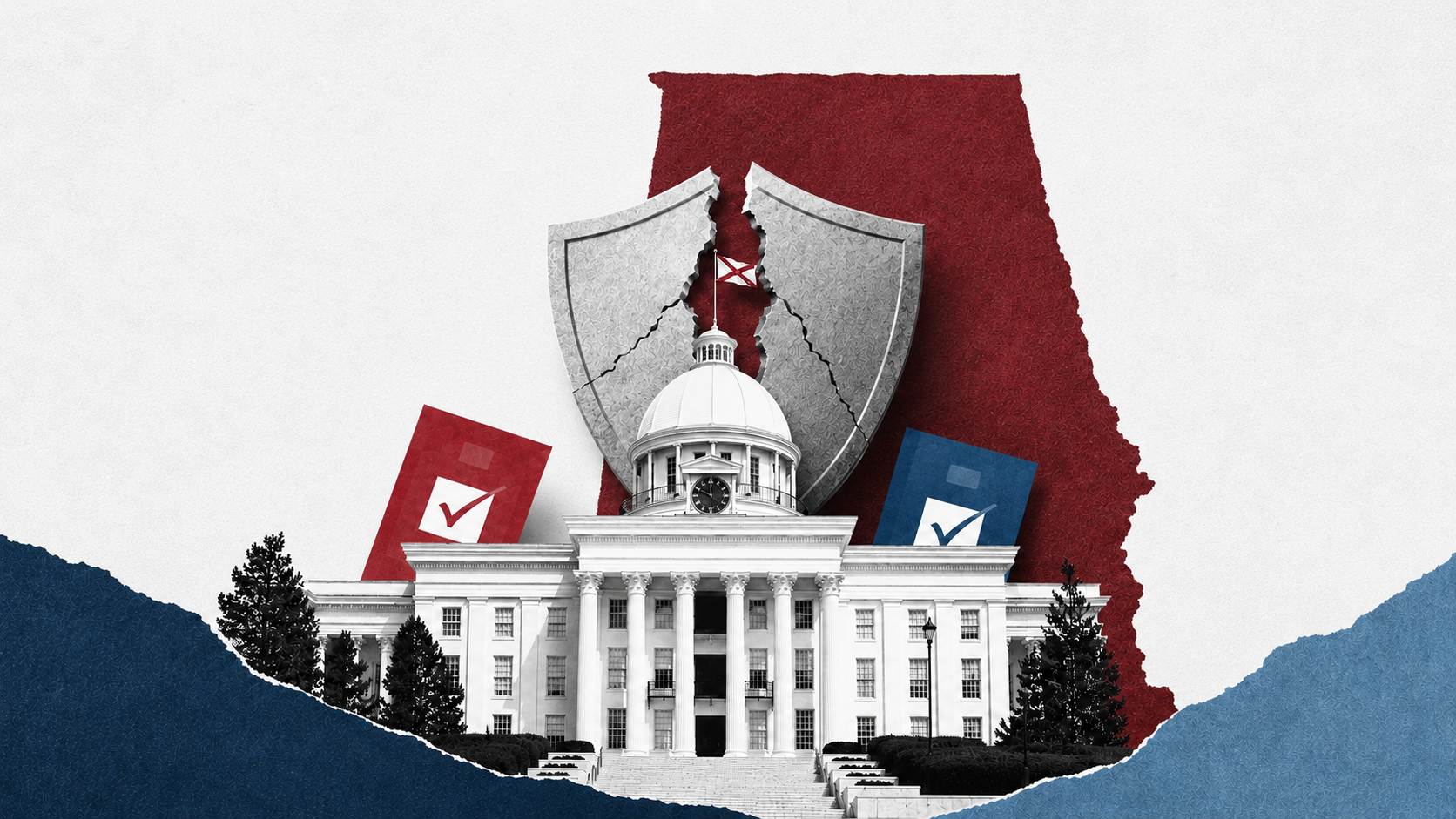
For years, incumbency in this state has functioned almost like political armor. Name recognition mattered. Fundraising mattered. Endorsements mattered. Relationships with powerful interests mattered. So did seniority, committee assignments and the quiet understanding that once a lawmaker survived long enough, removing them became harder, not easier.
That was especially true in low-turnout primaries, where organized support could often outweigh broader public dissatisfaction.
This year, that armor looked thinner.
Overall turnout in Alabama’s 2026 primary barely changed from 2022. But the makeup of that turnout changed dramatically. Republican primary ballots fell from 660,789 in 2022 to 493,376 in 2026, a decline of 167,413 votes. Democratic primary ballots increased from 188,578 to 364,635, a gain of 176,057 votes. Total ballots increased by only 6,327 statewide.
That is the story.
Alabama did not simply see a turnout change. It saw a different electorate show up.
And when the electorate changes, old assumptions collapse.
Incumbents build campaigns around expectations. They believe they know who will vote, what issues will move them, which endorsements still matter and which political alliances can carry them through another election.
Tuesday suggested that some of those assumptions are no longer reliable.
This was not simply a night of ideological purification. It was not only a conservative revolt, a Democratic shake-up or a local backlash against a handful of officeholders. It was something broader and more unsettled.
It was a warning.
Voters in both parties showed a willingness to challenge the familiar, reject the established and take a chance on something different. In race after race, incumbency was not enough. Experience was not enough. Institutional standing was not enough.
The defeat of Roberts was especially notable. Roberts was widely viewed as a well-connected establishment conservative with deep ties inside Birmingham-area Republican politics. He was not some marginal figure. He was part of the governing structure.
Albritton also lost despite years of legislative experience and his role as one of the Senate’s most influential budget voices. Albritton understood the State House, the budget process and the internal mechanics of government as well as almost anyone.
But voters do not always reward institutional knowledge in a moment of distrust.
Sometimes, they punish it.
On the Democratic side, Givan lost after years as one of the state’s most visible and outspoken Democratic lawmakers. Givan was not a quiet backbencher. She was a familiar voice, a recognizable presence and a political survivor.
Her defeat showed that anti-incumbent sentiment was not limited to Republicans, conservatives or one wing of state politics.
Datcher also fell, adding to the sense that voters were not merely sorting candidates by party or ideology. They were showing a broader restlessness with those already holding office.
That restlessness is not unique to Alabama.
Across the country, voters have grown tired of institutions that ask for trust but too often resist accountability. They are skeptical of insiders, suspicious of power and increasingly willing to reward candidates who promise disruption, even when disruption is the only thing they are offering.
Some of that skepticism is earned. Some of it is inflamed by grievance politics. Some of it comes from years of broken promises, national polarization and the sense among voters that government is too often responsive to power rather than people.
Whatever its source, the effect is real.
And Tuesday, it arrived in Alabama with force.
The danger is that anti-incumbency is not the same as reform.
Throwing out officeholders may feel like change, but change itself is not a virtue. It can produce better leadership, or it can produce less experienced leadership. It can open the door to new voices, or it can empower candidates whose only real argument is that they are not the person already in office.
That distinction matters.
Voters have every right to demand more from those who serve them. No officeholder owns a seat. No title belongs permanently to the person who holds it. Public office is not an inheritance, and incumbency should never be treated as a deed of ownership.
But democracy asks something of voters, too.
It asks them to judge not just who has been in office the longest, but who has served well, who has failed, who understands the work and who is capable of doing the job once the campaign signs come down.
A healthy democracy should be willing to remove incumbents.
A reckless one removes them without asking what comes next.
That is why Tuesday’s results should be read carefully. They were not automatically a triumph of reform. They were not automatically a rejection of competence. They were not proof that voters have moved sharply left or sharply right.
They were proof that voters are restless.
And in politics, restlessness is powerful.
It can renew government when it is paired with seriousness, judgment and purpose. It can also damage government when it is captured by anger, resentment or the shallow promise that being new is the same as being better.
Tuesday did not answer which direction Alabama is headed.
But it did show that the ground is shifting.
For generations, Alabama politics has rewarded stability, seniority and relationships. Lawmakers who stayed around long enough often accumulated the one thing every politician wants: protection. Protection from challengers. Protection from scrutiny. Protection from the ordinary volatility of public dissatisfaction.
That protection is weaker now.
The electorate is more fluid. Voters are more restless. Party labels still matter, but they do not explain everything. Endorsements still carry weight, but they no longer guarantee safety. Experience remains valuable, but it is no longer automatically persuasive.
That may be healthy in some cases.
It may be dangerous in others.
But it is undeniably different.
Tuesday did not produce one simple story. It produced several. But taken together, those stories point toward a larger truth: Alabama voters are no longer as willing to accept incumbency as an argument for continuation.
Not by itself.
Not without accountability.
Not without proof that holding office has meant doing something with it.
For the lawmakers who survived, the lesson should be clear.
The old protections are weaker.
The old assumptions are shakier.
And the old belief that incumbency is enough may be ending.
In Alabama politics, incumbency was once a shield.
Tuesday showed it can now be a target.