























Something troubling is unfolding in Alabama’s Republican race for lieutenant governor, and it reveals a shift in modern politics.
Alabama Secretary of State Wes Allen, a Republican candidate for lieutenant governor, recently said he has no regrets about criticizing fellow Republican John Wahl for attending a Ramadan interfaith dinner at the Anniston Islamic Center.
“I made no bones about this,” Allen said during an April 24 televised interview. “I am not apologizing. I am a follower and a believer of Jesus Christ.”
The host then asked Allen whether he would go to a mosque.
“My faith, no,” Allen answered.
“Not at all? Would you go to a synagogue?”
“No. No,” Allen replied. “My faith is what is most important to me.”
Allen later spoke about America’s Christian heritage and identity.
Those comments matter beyond one Republican primary or one candidate’s theology.
For most of American history, public officials understood a fundamental principle of leadership: They did not have to share another person’s faith to recognize that person’s dignity, citizenship or place in the nation’s civic life.
Governors visited synagogues. Presidents attended mosques. Mayors appeared at interfaith gatherings and religious celebrations outside their own traditions. They did so because public service in a constitutional republic requires engagement with all citizens, not only those who worship the same way they do.
That was once understood as a sign of civic and spiritual confidence.
Today, exclusion is increasingly being marketed as conviction, while separation from people of other faiths is being treated as authenticity.
Allen came under criticism after attacking Wahl for attending the Anniston event earlier this year. According to Wahl, the gathering included local officials, Christian pastors, elected leaders, candidates and community members who came together for an interfaith evening intended to encourage civic understanding and dialogue.
Yet Allen publicly declared, “You will never find me in an Islamic Center or a mosque.”
Millions of Christians sincerely believe their faith calls them to moral clarity and spiritual fidelity. The question is whether public officials should translate personal theology into civic separation.
Allen is Alabama’s secretary of state, the state’s chief elections official and a leading Republican candidate for lieutenant governor. His words carry cultural and political weight beyond a Sunday sermon or campaign rally.
Allen’s sharpest criticism did not come from secular activists or progressive commentators. It came from Wahl, a deeply conservative Christian, former chairman of the Alabama Republican Party and Allen’s opponent in the Republican primary for lieutenant governor.
Wahl accused Allen of “weaponizing Christianity” and responded with an argument rooted directly in the Gospels.
“Jesus did not stay in the synagogue,” Wahl said. “He went to the well to speak to the Samaritan woman, He entered the homes of the rejected, and He commanded us to go into all the world.”
Allen’s argument is essentially that entering a mosque or synagogue conflicts with Christian faithfulness. Wahl’s argument is that Christianity is strong enough to engage people who believe differently without surrendering conviction.
Historically, American conservatism did not fear that engagement. Ronald Reagan never viewed engagement with Jews or Muslims as a threat to Christianity or American identity. His conservatism was rooted in conviction and confidence.
Reagan understood something parts of modern politics seem to have forgotten: A strong faith does not require fear of proximity to people who believe differently.
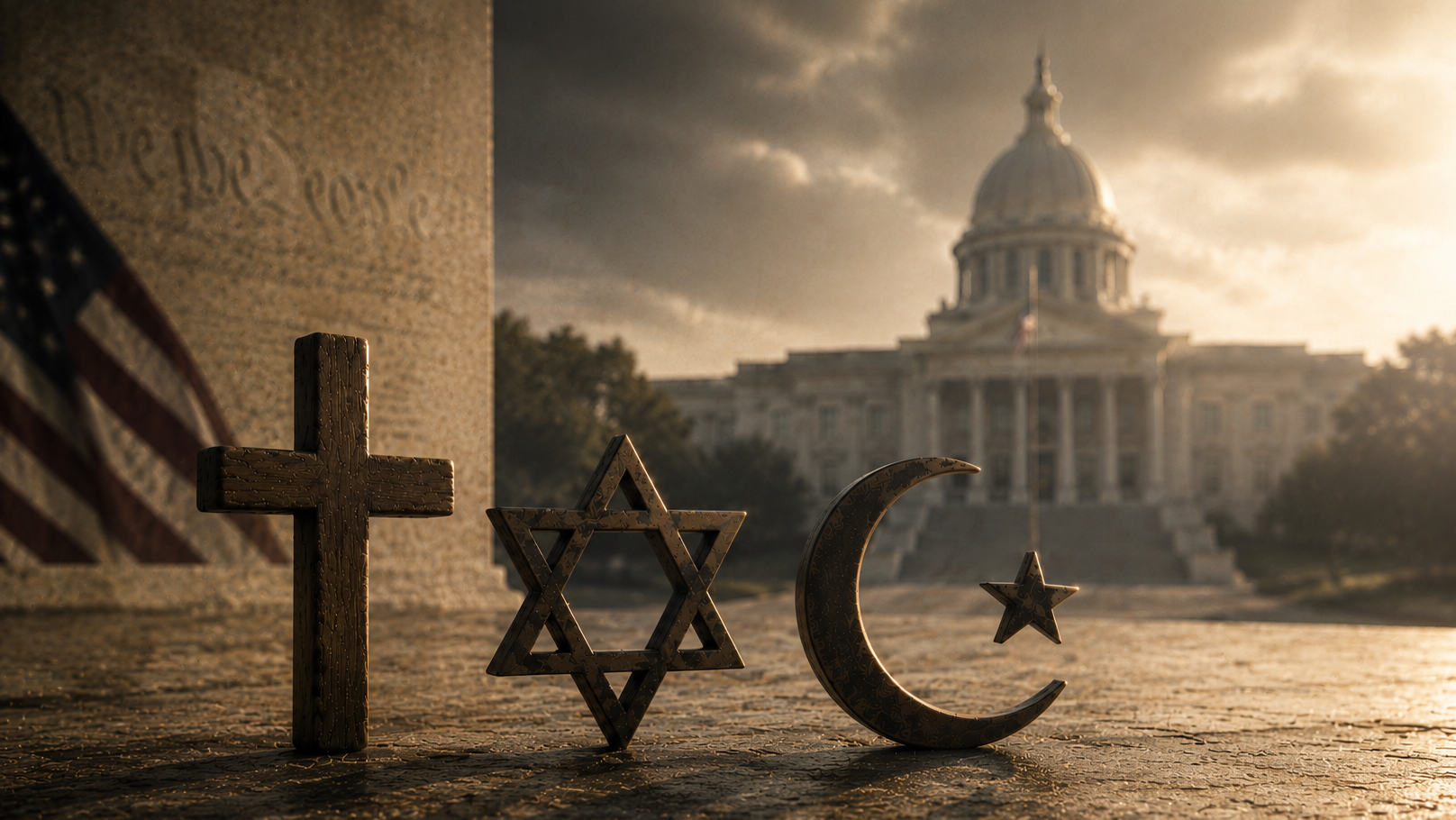
The Founders understood that danger as well. Having witnessed centuries of sectarian conflict in Europe, they rejected religious tests for office and protected the free exercise of religion in the First Amendment.
George Washington famously wrote to the Hebrew Congregation in Newport that the United States “gives to bigotry no sanction, to persecution no assistance.” Washington was defining the character of the republic itself—one in which citizenship would not rise or fall based on religious identity.
America has deep Christian influences and traditions. Alabama does as well. But the United States was never intended to function as a government where one religious group determines which faiths deserve civic legitimacy.
That becomes especially important in today’s climate.
Across the country, antisemitism has risen sharply in recent years. Synagogues increasingly operate under heightened security, while Jewish communities report growing harassment and intimidation.
Alabama has not been immune.
Jewish congregations in Birmingham, Montgomery, Huntsville and Mobile have long been part of the civic and philanthropic fabric of this state. Yet Jewish communities have also long understood the uneasy reality that they could contribute fully to society and still be viewed as somehow separate from the culture around them.
For Jewish families, a synagogue is not merely a religious building. It is tied to centuries of memory, endurance, displacement, survival and belonging.
The same is true for mosques and Muslim families throughout America.
These are houses of worship filled with citizens raising children, building businesses, paying taxes, serving communities and trying to live meaningful lives in the same Alabama everyone else calls home.
Civilized societies do not require uniformity of belief to sustain mutual respect.
Faith can inspire compassion, humility, courage, charity and moral conviction. At its best, religion calls people to see dignity in others even across profound disagreement.
But when faith becomes a mechanism for sorting citizens into insiders and outsiders, worthy and suspect, it ceases to strengthen a republic. It begins to fracture one.
History offers repeated warnings about what happens when politics begins dividing citizens into approved and unapproved communities of belief. Once religious identity begins determining who fully belongs in public life, citizenship itself slowly becomes conditional.
Words matter because political rhetoric shapes cultural permission structures. Politicians may not intend hostility, but when public officials repeatedly portray mosques and synagogues as places incompatible with American identity or Christian faithfulness, many citizens hear something deeper: that they are outsiders in their own country.
Entering another person’s house of worship is not surrender of belief. It is recognition that citizenship and human dignity do not depend upon religious uniformity.
A Christianity secure enough to engage the world does not weaken itself by entering a synagogue or a mosque.
That was once understood as a sign of strength. Some politicians now seem to believe the opposite.