

































We are living through instability, and we keep telling ourselves it’s because we no longer agree.
That explanation is too easy.
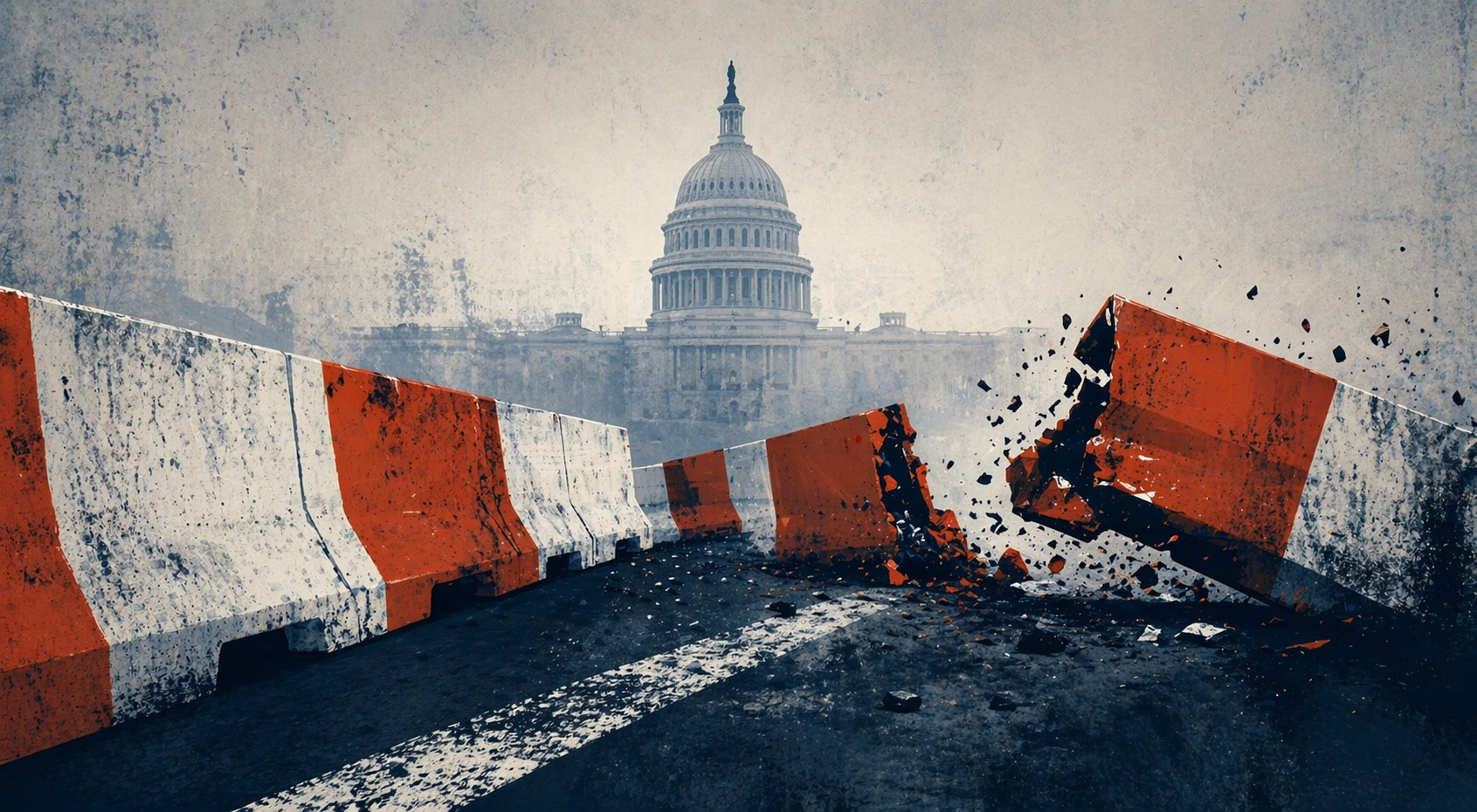
Stability was built on guardrails like rules, norms and institutional restraints that forced those in power to slow down, compromise and consider consequences before acting.
For a long time, those guardrails held, even when the country didn’t agree. Over the past decade, however, we’ve begun to remove them—not all at once, but enough to change how the system behaves.
Congress has grown less willing to check the executive, presidents have grown more comfortable testing the limits of their power, and the courts are increasingly seen not as neutral arbiters, but as extensions of political philosophy.
That didn’t happen by accident.
It happened because the incentives that once reinforced restraint have changed.
In Congress, polarization has made compromise politically dangerous. Members are rewarded for confrontation, not cooperation, and primary elections often punish those who work across the aisle. The result is a legislative branch that struggles to assert itself—not because it lacks authority, but because it lacks the political will to use it. Consider the repeated reliance on short-term spending measures and last-minute funding deals to avoid government shutdowns. The power of the purse—one of Congress’s most important constitutional guardrails—has increasingly been reduced to crisis management rather than deliberate governance.
At the same time, presidents have stepped into that vacuum. With Congress gridlocked, the executive branch has relied more heavily on executive orders, emergency powers and broad interpretations of existing law to act unilaterally. Whether on immigration policy, student loan relief or pandemic-era emergency measures, presidents of both parties have increasingly acted first and left the courts to sort out the limits later. Each step may be justified in the moment, but over time it resets expectations about what presidential power looks like.
The courts have followed a similar path. Changes to the confirmation process have made it easier to seat judges without broad consensus, reinforcing the perception that the judiciary reflects political alignment rather than institutional independence. At the same time, a growing willingness to revisit precedent has introduced more volatility into a system that once depended on continuity.
The consequences are no longer abstract.
In Dobbs v. Jackson Women’s Health Organization, the Court overturned Roe v. Wade, demonstrating a willingness to discard long-standing precedent—one of the judiciary’s most important stabilizing guardrails. In Trump v. United States, the Court recognized broad presidential immunity for official acts, raising fundamental questions about accountability and the limits that once constrained executive power.
Together, these decisions suggest a judiciary increasingly willing to operate with fewer of the restraints that once provided continuity, predictability and balance.
The same pattern can be seen in how the nation enters conflict. The Constitution places the power to declare war with Congress, a deliberate guardrail meant to slow decision-making and ensure broad accountability. Over time, however, presidents of both parties have increasingly relied on authorizations, emergency powers and unilateral actions to engage in sustained military operations without formal declarations of war.
The guardrail remains on paper. In practice, it has weakened.
And when those guardrails weaken at the national level, the consequences extend outside Washington and show up in places like Alabama.
In 2018, Alabama voters approved Alabama Amendment 2, embedding a strong pro-life position into the state constitution. At the time, it was framed as a moral statement—a declaration of values. But law does not operate in the abstract.
When the Alabama Supreme Court decided LePage v. Center for Reproductive Medicine, it relied in part on that constitutional language to treat frozen embryos as children under the state’s wrongful death statute.
The consequences were immediate. Fertility clinics paused IVF treatments. Families were left in uncertainty. A policy intended to protect life disrupted the very process that creates it.
The Legislature moved quickly to pass protections for IVF, but that response only underscored the larger problem. The guardrails weren’t there on the front end, and once the consequences arrived, lawmakers were forced to react, not govern.
This isn’t an isolated incident. In recent years, Alabama lawmakers have increasingly been forced into reactive lawmaking—passing legislation quickly to address unintended consequences, rather than working through those consequences on the front end.
This is the pattern we are living through. We are watching what happens when the structures designed to balance competing interests are weakened and when certainty replaces restraint.
Deeply held beliefs often shape public policy, but conviction alone is not a substitute for judgment. When belief is translated into law without regard for complexity, contradiction or consequence, the result is instability. And once that instability takes hold, it becomes very difficult to contain.
Stability can be rebuilt. But it doesn’t come from winning the next argument or passing the next law. It comes from restoring the guardrails—strengthening the institutions, respecting limits and accepting that restraint is a requirement of self-government.
That means Congress willing to govern, not posture. Presidents willing to respect limits, not test them. Courts willing to apply the law consistently, not selectively. Because in the end, stability is something we must choose to maintain.